Quick Answer
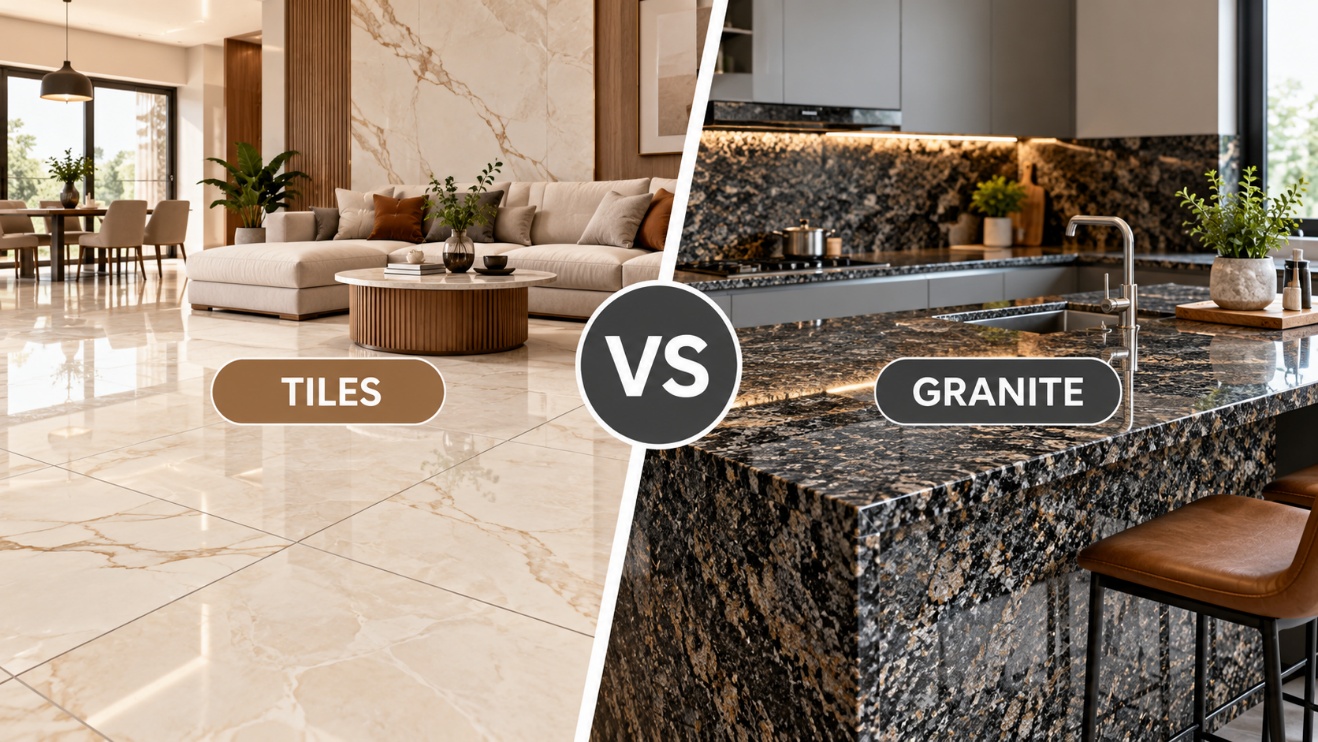
Tiles are made in a factory to a set size and finish, while granite is natural stone whose grain and care needs vary from stone to stone. So the tile vs granite choice comes down to the room. Anti-skid tiles are made for wet rooms such as bathrooms. Granite suits rooms where you want real stone grain, once you've asked about sealing and grip. Compare five things: water and stains, grip on wet floors, wear and repairs, looks and joints, and the full laid cost. Before you buy, ask for the finish and its slip rating.
Introduction
Tiles and granite are both laid as floors in Indian homes, and each can come with a polished, shiny face. But they don't react to water, spills and daily wear in the same way, and you look after them differently.
That matters because a floor is hard to change once it's laid. Below, we explain what each one is and compare them on the things you'll notice every day. Then we go room by room, and end with how a floor's finish and size can change the answer.
What is the difference between tiles and granite?
Start with what each floor is made of. That one fact shapes almost everything you'll compare later.
What tiles are
Floor tiles are made in a factory from clay and minerals such as feldspar. They're shaped in a press and then fired at high heat.
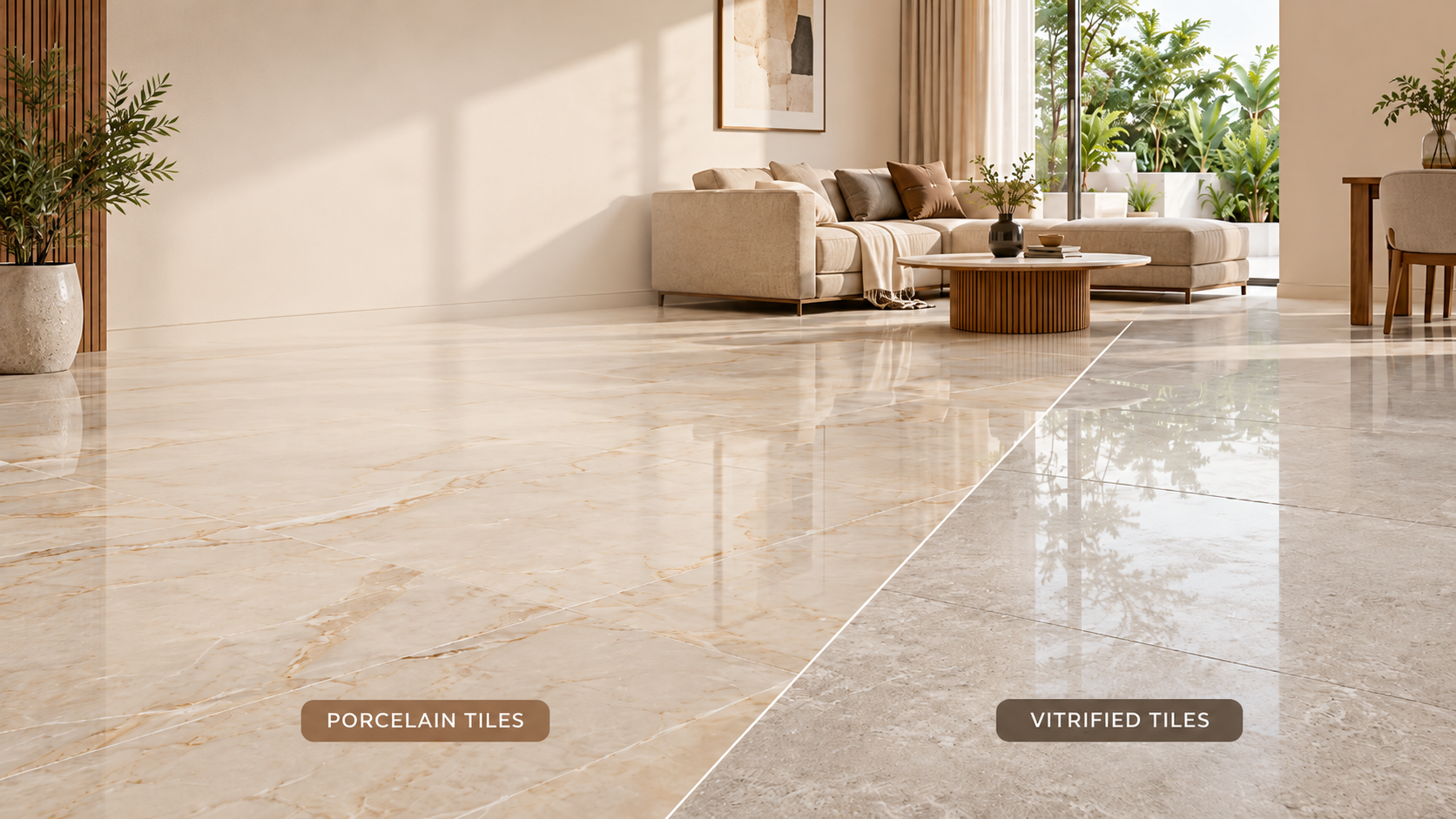
Ceramic tiles are usually lighter and suit walls and floors with moderate foot traffic. Vitrified tiles have a denser body, which gives them low water absorption, so they're the tiles to weigh up against granite for a floor.
Because a factory makes them, the tiles in a batch come out at the same size and finish. You can pick a face anywhere from high gloss to matt.
On glazed tiles, the design is printed into the glaze, the glassy top layer. That's how a tile can carry a wood, marble or stone look.
What granite is>
Granite is a natural stone. It forms when molten rock cools slowly deep underground, which is why you can see its crystals just by looking at it.
It's made mostly of quartz and feldspar. The stone is quarried, then cut and polished into slabs and tiles for floors, stairs and counters.
Several hard stones are sold as granite, so ask your supplier exactly which stone you're buying.
The difference that matters most
The biggest difference between tiles and granite is how much you can know before you buy.
A tile is made to a known size and finish, and tiles from one batch share the same shade. You can ask for its figures, such as water absorption and, for anti-skid tiles, the slip rating.
Granite is a piece of natural stone. Whether it needs sealing and how it handles acids depend on the exact stone, so you have to ask the supplier.
So the tile vs granite decision starts with different questions for each floor. Those questions fall into five areas you'll notice in daily life.
Tiles vs granite flooring: five things to compare
The five areas are water and stains, grip on wet floors, wear and repairs, looks and joints, and the full laid cost. Tiles come out ahead on some, granite on others, and a few depend on the finish you choose.
How tiles and granite differ at a glance
This table puts the two floors side by side, with what to ask before you buy.
Factor | Tiles | Granite | What to ask before you buy |
Water and stains | Vitrified tiles have low water absorption and resist stains | Sealing makes stone more stain resistant, never stain-proof | The tile's water-absorption figure, and whether your stone needs sealing |
Grip on wet floors | Matt and textured faces usually grip better than high gloss; Slip Shield tiles are rated R10 to R11 | Can be rated on the same R9 to R13 ramp scale | The R rating: R9 is the lowest class, R13 the highest |
Wear and repairs | A chipped or cracked tile can be swapped for a spare from your batch | A chipped piece has to be filled or matched by a stone mason | Keep one or two spare boxes of tiles; ask how a chipped stone piece would be repaired |
Looks and joints | Printed wood, marble and stone looks, in slabs up to 800x3000 mm | Natural grain with crystals you can see | Samples laid on your own floor, in daylight and lamplight |
Full laid cost | Adhesive and grout, plus 8 to 10% extra tiles for straight layouts and 15% for diagonal ones | Stone pieces bedded by a mason; sealing adds cost where the stone needs it | One fully laid price per square foot, labour and extras included |
Water and stains
Water matters most in rooms that get wet or messy every day, like bathrooms, kitchens and balconies.
Vitrified tiles take in little water because their body is denser than ceramic tile's. Our Duragres glazed vitrified tiles have low water absorption, and they resist stains, moisture and surface wear.
On a tiled floor, the grout between the tiles is the weak spot. Grout takes in more water than the tile itself, so have it sealed after laying and clean the joints with a soft brush and a mild cleaner.
With granite, it depends on the stone. Some stones need sealing and many don't, so ask your supplier about the one you're buying.
Sealing helps, but it doesn't make stone stain-proof. It only makes it more stain resistant. If oil or turmeric spills on granite, blot it at once with a paper towel, because wiping spreads it.
Verdict: for floors that get wet and messy every day, a dense vitrified tile is the easier choice. Only the grout needs sealing, not the whole floor.
Grip on wet floors
For wet floors, look at the face of the floor first. Matt and softly textured tiles usually grip better than high-gloss tiles in wet areas.
Soap and water make any floor slicker. That's why wet rooms need more grip than a dry bedroom.
For bathrooms, kitchens and balconies, we make Slip Shield tiles. They have a textured layer added on top, and they're rated R10 to R11 for slip resistance.
That rating comes from a ramp test. The scale runs from R9, the lowest class, to R13, the highest, so a higher number means more grip in that test.
Granite can be rated on the same scale. Before it goes into a bathroom or balcony, ask the supplier which finish they advise for a wet floor and what rating it has.
Verdict: for wet floors, pick the face first and ask for its slip rating, whichever material you choose.
Wear, scratches and repairs
Grit can scratch any polished floor, tile and granite included. Sand from shoes and grit under a dragged chair can both leave marks.
You can cut down on this with a few habits. Put mats inside and outside the door, fix felt pads under furniture legs, and lift heavy pieces when you move them.
A heavy pot or steel vessel dropped on a hard floor can chip it, whether it's tile or stone. What differs is the repair.
With tiles, a chipped or cracked tile can be lifted out and swapped for a spare. Tile shade can vary slightly between production batches, so keep one or two boxes from your batch once the job is done.
For granite, check how a chipped piece would be filled or matched later. It's easier to settle that before the floor goes down.
Verdict: with tiles, you can plan repairs ahead with spare boxes, while granite needs that talk with your supplier first.
Looks, sizes and joints
Granite's look comes from its own crystals, which you can see in the polished stone. Its colour comes from its minerals, and true granite comes in shades such as red, pink, grey and white.
Tiles carry a printed design, so you can choose a wood, marble or stone look. Tiles from one batch match in shade, so the floor looks even.
Any floor laid in pieces has joints, and grout fills them. Bigger pieces mean fewer joints, and tiles come in large slab sizes as well as standard ones.
Verdict: choose granite for the grain of real stone, and tiles for a set design, a wood or marble look, or big slabs with few joints.
Granite vs tiles price: what decides the full cost
A rate per square foot is only one line of the bill. Laying, extra pieces, grout and care can change which floor costs less in the end.
Laying is a big part of that bill, and the two floors are laid differently. Tiles are fixed with an adhesive that suits their size and weight, and the floor needs time to cure before you use it.
Granite comes as solid pieces of natural stone. Ask for a mason who has laid stone before, and ask what the stone will be bedded in. Both answers change the labour line on your quote.
For tiles, buy extra to cover cuts. Allow about 8 to 10% extra for a straight layout and 15% for diagonal or herringbone patterns. Then add adhesive, grout and the spare boxes you'll keep.
With granite, ask whether the stone needs sealing, and whether the quote covers laying, filling the joints and finishing the surface. These can show up as separate lines on the bill.
Ask each supplier to quote for the same things: material, laying, joints and any sealing or finishing. Then compare the two quotes as a fully laid price per square foot.
Verdict: compare full laid quotes for your exact tile and your exact stone, not the price on the sample.
Tips for choosing between tiles and granite
- Look at samples on your own floor in daylight and in the evening, because colours can look different under your lights.
- Ask for the slip rating of any floor going into a bathroom, kitchen, balcony or staircase.
- Keep one or two boxes of spare tiles from the same batch for future repairs.
- Get fully laid quotes for both floors, so you're comparing the same things.
Mistakes to avoid when choosing between tiles and granite
- Don't put a high-gloss tile on a floor that gets wet. A matt or textured face usually grips better there.
- Avoid trusting "stain-proof" promises for any floor. Sealing only makes stone more stain resistant, and the grout between tiles can still discolour.
- Don't pick one floor for the whole house without thinking about each room. These five areas don't weigh the same everywhere: a kitchen cares most about stains, and a bathroom cares most about grip.
Tiles or granite: which is better, room by room
So the right floor can change from one doorway to the next. Start with the rooms where water decides it.
Bathrooms and wet balconies
Bathroom floors get wet every day, and soap makes them slicker. Here, grip and water come first.
Our Slip Shield tiles are designed for bathrooms and balconies, and they come in ceramic and Duragres glazed vitrified tiles. The fine texture on top helps your feet grip when the floor is wet or soapy.
If you'd still like granite in a bathroom, ask the supplier for a wet-floor finish with a known R rating, and whether the stone needs sealing.
Verdict: anti-skid tiles are the straightforward pick for bathrooms and wet balconies.
Kitchens
An Indian kitchen floor gets oil, turmeric, water and the odd dropped steel tumbler. Pick a vitrified tile that resists stains, and wipe spills up right away.
Keep an eye on the grout, because it's the part of a tiled floor that can stain.
Granite can work in a kitchen too, as long as you blot spills quickly. Ask whether your stone needs sealing before oil and turmeric reach it.
Near the sink and stove, a matt or anti-skid tile adds grip where water and oil land.
Verdict: a matt vitrified tile handles stains and grip in one choice, and granite works if you're ready to blot spills fast.
Living rooms and bedrooms
These rooms stay dry, so the choice here comes down to looks and wear from furniture.
Granite suits a living room if you want real stone with its visible crystals. Tiles suit it if you want a set design, a marble or wood look, or large pieces with few joints.
Verdict: tiles and granite can both work in dry rooms, so choose on looks and the full laid cost.
Stairs and entrances
Stairs and entrance steps need grip on the tread, because shoes bring in water and dust.
Pick an anti-skid step tile for a tiled staircase. For granite steps, ask for a finish that grips when wet, with the R rating in writing.
Parking and outdoor areas
Outdoor floors face sun and rain, and a parking area also takes the weight of a car.
Our Durastone tiles are made for parking areas and terraces. They're built to bear heavy loads and have a matt or structured face for grip.
For granite outdoors, check that the stone suits outdoor use and find out which finish grips when wet.
If you're unsure about a wet or outdoor floor, get the slip rating in writing and ask your tiler or mason which finish they'd lay there.
In each of these rooms, the finish matters as much as the material.
How finish and size change the tile vs granite choice
That's because the face of a floor decides how it grips and how it shows wear. Size matters too, since it sets how many joints you'll see.
Glossy, matt and textured faces
A shiny face shows off the pattern and reflects light around the room.
In a wet room, the finish can change which floor you should pick. Tiles are a good choice for bathrooms and kitchens only if you pick a matt or textured face, so keep glossy tiles for dry rooms.
Granite can be polished to a high shine too. Ask how a polished stone grips before you lay it anywhere near water.
Large tiles and slabs
If you want a floor with few joints, size changes the picture. A 600x600 mm tile leaves a joint every 600 mm. A 1200x1800 mm tile leaves far fewer lines, and our Coverstone slabs, which are made for floors too, go up to 800x3000 mm.
Fewer joints also mean less grout to keep clean. Large pieces need careful laying, so ask your tiler whether they've laid that size before.
Hard top coats
For a busy hallway or living room, a hard top coat changes how a tile copes with wear. Our VC Shield tiles have a clear protective layer over the printed glaze.
They reach up to 50,000 revolutions in a wear test that rubs the surface over and over. So in a busy room, a coated tile is a strong option.
Which granite you're buying
With granite, the stone itself can change the answer. Stones made mostly of quartz, feldspar and mica, like true granite, generally resist most acids found in a kitchen.
Even so, acid cleaners aren't advised, because some stones contain minerals that acids can attack. So check whether your stone needs sealing and how it should be cleaned.
Key Takeaways
- Tiles come in set sizes and finishes; granite varies from stone to stone.
- Vitrified tiles take in little water, while granite's sealing needs depend on the exact stone you buy.
- For any wet floor, choose a matt or anti-skid face with a known R rating.
- Keep spare tile boxes for chips and repairs, and check how a chipped granite piece would be matched.
- Compare fully laid quotes that include laying, extra tiles, grout, sealing and finishing, not the sample price.
- Anti-skid tiles suit bathrooms and wet balconies, and tiles and granite can both work in dry living rooms.
- Gloss or matt, tile size and a hard top coat can shift the verdict as much as the material.
Conclusion
Choosing between tile and granite comes down to how each room is used. Floors that get wet and messy need grip and easy spill care. Dry rooms leave you free to choose on looks and budget.
So in bathrooms, wet balconies and busy kitchens, a matt or anti-skid vitrified tile covers grip and stains in one go. In living rooms and bedrooms, granite is a fair choice if you love real stone and have asked about sealing and repairs. A tile with a hard top coat is another good option there.
Whichever way you lean, get the finish and slip rating in writing, compare fully laid quotes, and keep spare tiles from your batch. To see how a tile would look in your own room before you decide, try our tile visualiser.
FAQs
Are tiles cheaper than granite?
Not always. It depends on the exact tile and stone you compare, because the price per square foot is only part of the bill.
For tiles, add 8 to 10% extra for straight layouts, plus adhesive and grout. For granite, add sealing if your stone needs it, and check whether laying and finishing are in the quote. Compare fully laid quotes for both before you decide.
Which is more durable, tile or granite flooring?
It depends on the exact product and its face. Grit and dragged furniture can scratch any polished floor, and a heavy dropped vessel can chip tile or stone.
On tiles, a hard top coat helps a busy floor resist wear, and a chipped tile can be swapped for a spare from your batch. For granite, check with the stone seller how a chip would be filled or matched.
Does granite flooring need more maintenance than tiles?
It can. Whether your granite needs sealing depends on the stone, so check with whoever sells it to you.
Sealing makes stone more stain resistant, but spills like oil still need blotting straight away. On a tiled floor, the part to look after is the grout: have it sealed after laying and clean it with a soft brush and a mild cleaner.
Can tiles look like granite?
Yes. Glazed vitrified tiles carry a printed design, so they can show a stone look. Ask to see the design next to a real granite sample before you order.
Tiles from one batch match in shade, so the floor looks even. Real granite shows its own crystals, so compare a few samples on your own floor in daylight.
Is granite good for kitchen and bathroom floors?
Granite can work in a kitchen if your stone suits it and you blot oil and turmeric spills quickly. Ask whether it needs sealing first.
In a bathroom, grip matters most, so ask for a finish meant for wet floors and how it's rated for grip. Our Slip Shield tiles are designed for bathrooms and kitchens and are rated R10 to R11, which makes them a simple choice for those rooms.
Is granite flooring slippery when wet?
It can be, depending on its finish. Water and soap make any floor slicker, and a polished face needs care near water.
Ask for the finish and its slip rating on the R scale, where R9 is the lowest class and R13 the highest. For bathrooms and balconies, choose a floor whose rating you know.
Does granite flooring need sealing?
Not always. Whether a granite floor needs sealing depends on the exact stone, so ask your stone supplier before it's laid.
Where sealing is used, it makes the stone more stain resistant, but it doesn't make it stain-proof. Spills still need blotting straight away.
Is granite better than vitrified tiles?
Not across the board. Vitrified tiles resist moisture and stains and come in set sizes and finishes, including anti-skid faces for wet floors. Granite gives you the grain of real natural stone.
So vitrified tiles suit bathrooms, wet balconies and busy kitchens, and granite suits rooms where you want real stone and have asked about sealing.
Granite or tiles for stairs: which is better?
Choose whichever gives the tread better grip. Pick an anti-skid step tile for a tiled staircase.
For granite steps, ask for a finish that grips when wet and how it's rated. Get that rating in writing before the steps are laid.
Can you use tiles and granite in the same home?
Yes. You can choose room by room, for example anti-skid tiles in the bathroom and granite in the living room or on the stairs. Each room then gets the floor that suits how it's used. Where the two floors meet, ask your tiler or mason to plan the join.