Quick Answer
Porcelain and vitrified tiles mainly differ in what each name tells you. "Porcelain" means a tile that soaks up 0.5% of its weight in water or less. "Vitrified" is the name used in India for dense tiles fired until they're glass-like. So the porcelain tiles vs vitrified tiles choice comes down to five things: water absorption, grip on wet floors, finish and wear, laying, and price. Don't pay extra for the word "porcelain" unless the box or technical sheet shows that figure. For bathrooms, pick a low figure with a matt or anti-skid face.
Introduction
Porcelain and vitrified are two names you'll see on tile boxes and price quotes across India. Both are used for dense tiles for floors and walls, and their meanings overlap.
That overlap is what makes the choice confusing. It can also lead you to pay more for a label than for what's actually in the box.
Below, we explain what each name means, then compare the two on five things you'll notice at home. After that, we go room by room and look at how the finish changes the answer.
The difference between vitrified and porcelain tiles
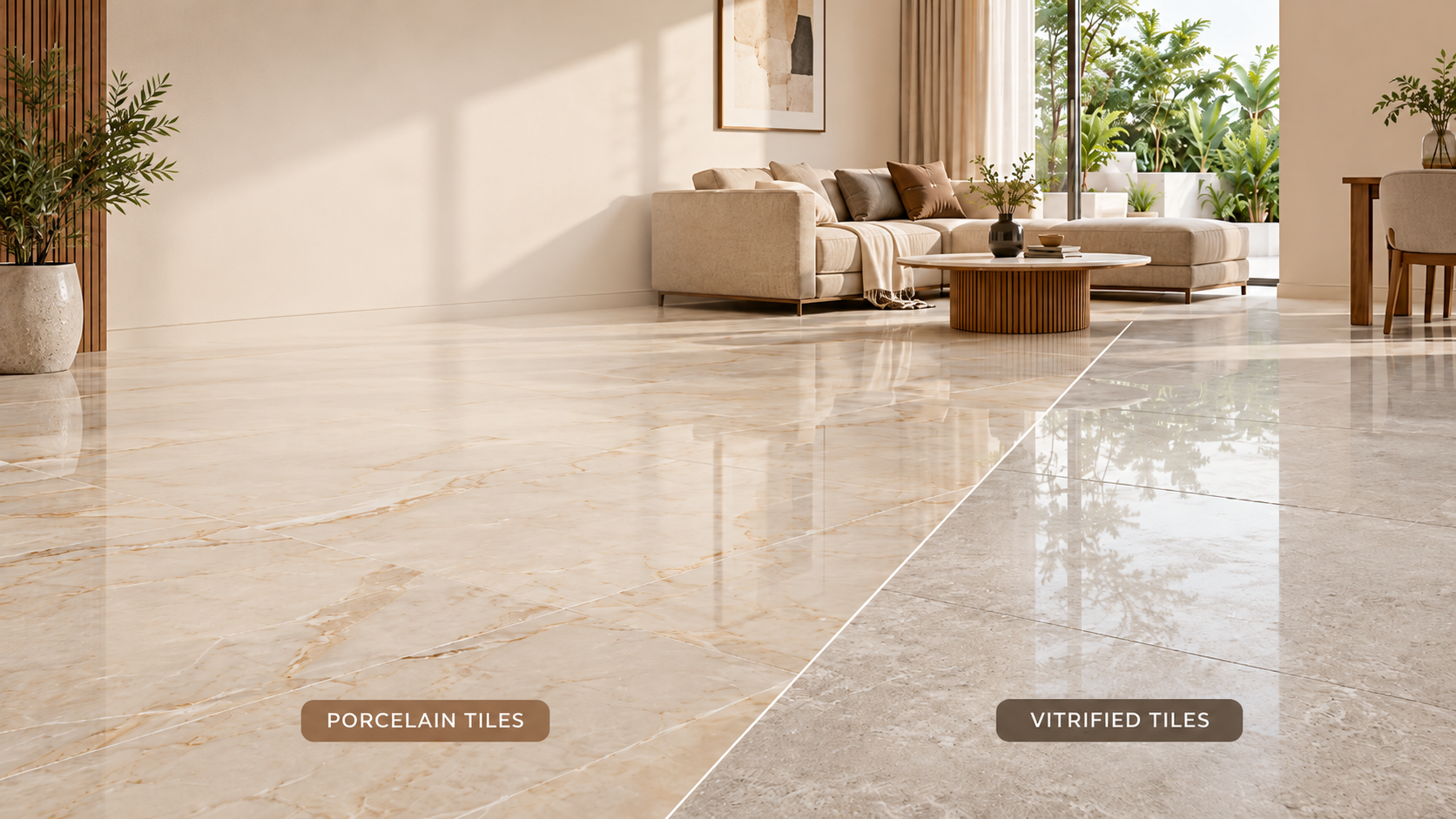
Porcelain is a name tied to one test result, while vitrified describes how a tile is made. So one tile can carry both names, as long as it passes the porcelain test.
What a porcelain tile is
Tile standards give porcelain a fixed meaning. A tile counts as porcelain when it soaks up 0.5% of its own weight in water or less. A tile that takes in more than that isn't porcelain, whatever the box says.
Standards call a tile like this "impervious", which simply means hardly any water can get into it. On a technical sheet, you may also see it shown as group BIa. That's the group in the international tile standard for tiles that soak up the least water.
The word on the box isn't proof by itself. A tile can be sold as porcelain without meeting the 0.5% mark.
What a vitrified tile is
A vitrified tile is fired at high temperatures until the inside turns dense and glass-like. As a result, it soaks up little water. Our Duragres glazed vitrified tiles are made this way, and their dense, low-porosity body helps them resist stains and moisture.
In shops, you'll see vitrified tiles sold as polished (PVT), glazed (GVT) or full body. Each one counts as porcelain only if its sheet shows the porcelain water figure.
Why the names overlap, and the one number that sorts them
Porcelain tiles are typically made with their own kind of clay, but tile standards give the name by the water figure alone.
Knowing this keeps you from paying more just for the word porcelain. It also stops you assuming that every tile sold as vitrified passes the porcelain test.
So the water absorption figure is the one number that sorts the two names. Look for it on the box or the technical sheet. It comes from a lab test, so you can't check it at home.
Porcelain tiles vs vitrified tiles: five things to compare
That figure is the first of five things worth comparing. The other four are grip on wet floors, the finish and how it wears, laying, and price. The porcelain or vitrified label tells you nothing about any of those four.
Porcelain vs vitrified tiles compared factor by factor
Only the first row depends on the porcelain figure. The other five depend on the tile's face, its size and the quote.
Factor | What to check | What suits well | Best for |
Water absorption | The figure on the box or technical sheet; 0.5% or less meets the porcelain definition | Any tile at or under 0.5%, whatever its label | Bathroom and kitchen floors |
Grip on wet floors | A matt or textured face, or a slip rating such as R10 to R11 | Anti-skid tiles with a slip rating on the box | Bathrooms, balconies, terraces and pool decks |
Surface wear | A hard clear coat over the glaze, and its abrasion figure | Tiles with a hard clear coat over the glaze | Busy living rooms and corridors |
Everyday marks | Whether the face is polished or matt | Matt or soft-textured vitrified faces, which hide everyday marks well | Kitchen floors |
Laying | How dense and how big the tile is, and which adhesive suits it | A tiler who has laid that size, with an adhesive matched to the tile | Large sizes such as 800x1600 mm and up |
Price | The full laid cost for the same size and finish, plus wastage and spare boxes | A quote for the whole job, compared like for like | Comparing two dealers' quotes |
Water absorption: the figure behind the porcelain name
This is the only factor the porcelain name speaks to. Any tile that meets the figure counts, whether the box says porcelain or vitrified.
To compare two tiles you're choosing between:
1. Ask the dealer for the technical sheet of each tile.
2. Find the line for water absorption, shown as a percentage.
3. Check the group too, if it's listed. Group BIa is the porcelain group.
4. Put the two figures side by side and see which one sits at or under 0.5%.
If both tiles meet the figure, they tie on water. If only one sheet shows a figure, that's the only tile you can be sure about.
Verdict: choose by the figure on the sheet, then decide on the other four factors.
Grip on wet floors
Grip comes from the face of the tile, and neither name tells you how slippery a tile gets when it's wet. Matt or soft-textured faces usually grip better than high gloss in wet areas like a bathroom.
For extra grip, look for a slip rating on the box. Our Slip Shield tiles get a fine textured layer added after the design is printed, and they're rated R10 to R11 for slip resistance.
In testing, they reach friction values of up to 0.6 to 0.7 when dry, and 0.5 to 0.6 when wet or soapy. They come in ceramic and glazed vitrified tiles, for bathrooms, kitchens, balconies, terraces and pool decks.
Verdict: for wet floors, choose a matt or anti-skid face.
Finish, wear and everyday marks
The same dense tile can have a polished, glazed or matt face. That face decides how the tile shines, how it wears and how much it shows marks.
It decides the look too. A wood or stone look is printed into the glaze, so it has nothing to do with whether the box says porcelain or vitrified.
For busy floors, a hard clear coat over the glaze helps against wear. Our VC Shield tiles carry this coat and are tested to up to 50,000 revolutions in an abrasion test.
That compares with 12,000 revolutions or more for PEI 5 on the standard wear scale. PEI is a wear rating for glazed surfaces. VC Shield works on both ceramic and vitrified tiles, so the name on the box doesn't matter here.
Matt or soft-textured vitrified faces hide everyday marks well, so they suit a kitchen floor.
Verdict: pick a matt face for the kitchen, a hard-coated face for busy floors and a polish for dry rooms.
Laying the tiles
Porcelain tiles are harder to bond and harder to cut. So if your tile meets the porcelain water figure, tell your tiler, whatever the box calls it.
The tile adhesive should match the tile material and where it's going, because a mismatched adhesive can leave the bond weak or patchy.
Our ranges go up to 1200x1800 mm.
Before work starts:
1. Check that all the boxes come from the same production batch, since shade can vary slightly between batches.
2. Tell your tiler the exact tile and size you've chosen.
3. Ask how they plan to fix and cut it.
4. Check that they've laid tiles of that size before.
5. Ask which tile adhesive they'll use for that tile and that room.
6. Make sure they follow the adhesive's mixing instructions and the tile's laying instructions exactly.
Verdict: agree to the tile, its size and the adhesive with your tiler before work starts.
Porcelain tiles vs vitrified tiles price: what sets the cost
A rate per square foot is only one line of the bill. You'll also pay for laying, adhesive, grout and the extra pieces lost to cutting. The range, finish and size all change the rate as well.
For those cut pieces, plan on about 5–10% extra for simple layouts, and more for diagonal or patterned laying. Confirm pack sizes with your dealer.
Two tiles with the same water figure, size and finish can still be priced differently. So ask each dealer for a laid cost for the same size and finish.
If you're weighing a tile sold as porcelain against one sold as vitrified, check both sheets first. When both meet the water figure, any price gap comes from the range, finish and size.
Plan for spares as well. Keep one or two boxes back once the job is done. A spare from the same batch blends in if a tile ever needs changing.
Verdict: pay extra only for a lower water figure or a finish you need.
These five factors don't weigh the same in every room, though. A bathroom floor needs grip first, while a living room needs a face that copes with grit walked in from outside.
Which is better, porcelain or vitrified tiles? Room by room
So the better choice changes with the room. Wet rooms need a low water figure and a face with grip. Dry rooms let you choose on looks and on how the face handles grit.
Bathroom floors and walls
For a bathroom floor, pick a tile with a low water figure and a matt, soft-textured or anti-skid face. Look at samples both dry and wet before you decide.
Nobody walks on bathroom walls, so gloss and satin ceramic or vitrified tiles work well there and wipe clean easily.
Waterproofing behind the wet walls and a floor that slopes properly to the drain matter as much as the tile does.
Kitchens
A kitchen floor needs to resist stains, mop easily and give enough grip around the cooking area. Matt or soft-textured vitrified tiles hide everyday marks well, and mid-to-large sizes leave fewer grout lines to scrub.
On the wall behind the hob, smooth, low-porosity tiles clean faster after oil and spice splashes. Glossy ceramic and VC Shield tiles help the wall stay clearer under repeated wiping.
Living rooms and bedrooms
These rooms stay dry, so you can choose mainly on looks and on how the face handles grit. Large formats give fewer grout lines and a more continuous look in open spaces. Mid sizes such as 600x600 mm or 600x1200 mm suit most Indian homes.
A polished face works well in these dry rooms.
Balconies and terraces
Balconies and terraces get rain, so grip matters most there. Anti-skid tiles like Slip Shield are designed for balconies, terraces and pool decks. Whatever you choose for outside, check that the maker lists the tile for outdoor use.
Tips for checking porcelain or vitrified tiles at the showroom
● Shortlist by where the tile goes first, then by size, finish and look.
● Ask for the tile's sheet and find the water figure before you look at prices.
● Ask whether the tile is polished, glazed or full body, because that changes how it wears.
● Check samples in daylight and under lamps, because colour and texture can look different in each.
● For a bathroom, look at the sample wet as well as dry.
● Look for a slip rating on any tile meant for a wet floor.
● Buy one or two spare boxes from the same batch as your order.
Mistakes to avoid when choosing between porcelain and vitrified tiles
● Don't pay more for the word porcelain alone, because a tile can carry that name without meeting the 0.5% mark.
● Don't try to judge the figure with a few drops of water on a sample. The real figure comes from a lab test, so ask for the sheet.
● Avoid high-gloss faces on wet floors, because matt and soft-textured faces usually grip better there.
● Never compare quotes for different sizes or finishes as if they were the same tile, because size and finish change the cost.
When there's no figure to go on
Sometimes the box doesn't show how much water a tile soaks up. Ask the dealer for the tile's technical sheet: the water absorption percentage, or a group such as BIa, settles the question.
If the dealer can't give you either, you can't know whether the tile counts as porcelain. Choose a tile whose sheet shows the figure, and check it for every tile on your list, since it can differ from one tile to the next.
Once you've found tiles with a figure, the face decides the rest: the grip on wet floors, how marks show and the look.
How finish, size and Indian weather change the choice
That face comes in three main forms. A polished face suits dry rooms, a glazed face carries the design and extras like grip, and a full-body tile keeps its colour if it chips.
Polished vitrified tiles
A polished tile has its face ground to a shine. Our Vitro range of polished vitrified tiles comes in matte and full polish finishes, and suits corridors and large living spaces.
Choose full polish for dry rooms where you want the shine. Keep a high polish out of wet rooms, where matt and anti-skid faces usually grip better.
Glazed vitrified tiles
A glazed vitrified tile has its design printed into a glaze on top, which is how it can look like wood or stone. Duragres comes in gloss, satin and matte, and in textured wood and stone looks.
Pick a glazed tile when you want a particular look. For wet floors, choose one with an anti-skid face like Slip Shield. For busy floors, choose one with a hard clear coat like VC Shield.
Full-body tiles
On a full-body tile, the colour runs right through. Our Vitro Tech Homogenea tiles have the same make-up all the way through. On a glazed tile, the body under the design can be a different colour.
So if a full-body tile gets worn or chipped, the colour underneath still matches the face. Choose it for corridors and other floors that see heavy foot traffic.
You may also hear an unglazed porcelain tile called "through body". It means the same thing: the colour runs from the top of the tile to the bottom.
Tile size
Small tiles suit showers and detail areas. Match the size to the room and to how much grout you're happy to clean. For the largest sizes, ask your tiler the same questions as before.
Monsoon, grit and the Indian home
During the monsoon, wet feet and mud come in from outside, so the entrance, balcony and bathroom floors need a face with grip. Anti-skid tiles like Slip Shield are tested both dry and wet or soapy, so when you compare them, ask for the wet or soapy figure too.
Key Takeaways
● Porcelain means a tile that soaks up 0.5% of its own weight in water or less.
● Vitrified describes a dense, glass-like tile, so one tile can be both vitrified and porcelain.
● Check the water figure on the tile's sheet, because a tile can be sold as porcelain without meeting it.
● Grip, wear, looks and everyday marks come from the tile's face, so pick matt or anti-skid for wet floors.
● Tiles that meet the porcelain figure are harder to bond and cut, so agree the tile, size and adhesive with your tiler.
● Compare full quotes that include laying, wastage and one or two spare boxes.
● If a dealer can't show a water figure, choose a tile whose sheet does.
● Choose polished for dry rooms, glazed for a particular look, and full body for busy floors.
Conclusion
Choosing between porcelain and vitrified tiles takes three checks. First, look at the water figure. If it's no higher than 0.5%, the tile counts as porcelain, whichever name it's sold under.
Second, match the face to the room. Bathrooms, balconies and terraces need a matt or anti-skid face. Kitchens do well with a matt or soft-textured face that hides marks, and dry living rooms can take a polish. Glazed tiles give you wood or stone looks, and full-body tiles keep their colour if they chip.
Third, compare full quotes for the same size and finish, including laying and a couple of spare boxes from the same batch. Use our store locator to find a dealer or one of our experience centres near you. There, you can see samples in real light and ask for the sheet for every tile on your list.
FAQs
Is there a real difference between vitrified tiles and porcelain tiles?
Yes, but the difference is in what each name tells you. Porcelain means a tile that soaks up 0.5% of its weight in water or less. Vitrified means a tile fired until it's dense and glass-like. A vitrified tile that tests at or under that figure counts as porcelain too, so check the figure on the sheet.
Are porcelain tiles more expensive than vitrified tiles?
Not necessarily. What you pay depends on the range, finish and size, plus laying, adhesive, grout and the pieces lost to cutting. Two tiles with the same water figure can still be priced differently. Ask each dealer for a laid cost for the same size and finish, and pay extra only for a lower figure or a finish you need.
Are porcelain tiles better than vitrified tiles for homes?
Only if the porcelain tile has a lower water figure or a face that suits your room better. A vitrified tile with a low enough water figure already passes the porcelain test.
For dry living rooms and bedrooms, choose a polished or glazed face you like the look of.
Is GVT the same as porcelain?
Not always. GVT means glazed vitrified tile: a dense vitrified body with a printed glaze on top. It counts as porcelain only if its water absorption meets the same porcelain limit. Check the sheet for the tile you like to see its water figure.
Which is better for a bathroom floor, porcelain or vitrified?
Pick whichever has a low water figure and a matt, soft-textured or anti-skid face. Those faces usually grip better than high gloss on wet floors. Waterproofing behind the wet walls and a floor that slopes properly to the drain matter as much as the tile.
How can I tell if a tile is porcelain?
Look for the water absorption figure on the box or technical sheet. If it's no higher than 0.5%, the tile passes the porcelain test. You can't check this at home, because the figure comes from a lab test. If the seller can't show you a figure, the word porcelain on the box doesn't prove anything by itself.
Do vitrified tiles scratch easily?
They're dense and durable, but grit under furniture or dragged objects can mark any floor, including polished vitrified tiles. Felt pads under furniture, entrance mats and regular sweeping help protect the shine. Lift heavy pieces when you move them so you don't drag them. Matt faces hide everyday marks well.
Can vitrified tiles be used outdoors?
Yes, if the tile is made for outdoor use. Check that the maker lists it for outside, and pick a face with grip, since rain makes open floors wet. Anti-skid tiles like Slip Shield are designed for balconies, terraces and pool decks. For parking and driveways, our Durastone heavy-duty vitrified tiles come in 10 mm, 12 mm and 15 mm thicknesses.
Is porcelain stronger than vitrified tile?
Not as a rule. Porcelain is defined by how much water a tile soaks up, so the name doesn't promise extra strength. For wear on busy floors, look for a hard clear coat like VC Shield. For grip, check the slip rating on the box.
Are all vitrified tiles porcelain?
No. Only those at 0.5% or less meet the porcelain definition.
Vitrified describes how a tile is fired, while porcelain depends on a measured water figure. So being vitrified doesn't make a tile porcelain on its own. Check the water absorption figure on the sheet of each tile you shortlist.