Quick Answer
To choose the right adhesive for tiles, match the code printed on the bag to your tile, wall or floor, room and tile size:
- C1T for small ceramic or vitrified tiles in dry indoor spots
- C2T for other vitrified tiles and laying new tiles over old ones
- C2TE for big tiles indoors
- C2TES1 for outside walls and wet or submerged areas
- C2TES2 for slabs on surfaces that move
Picking the wrong grade, or adding extra water to make it spread, weakens the grip and can leave hollow tiles. On wood, metal or glass, a two-part PU adhesive is the fix.
Introduction
Tile adhesive is the ready-made mix that holds tiles to a wall or floor. It comes in several grades, and each grade is made for certain tiles, surfaces and rooms.
Picking the right grade matters, because a poor match can leave tiles loose or hollow later. The codes printed on the bags can be hard to follow.
Below, we explain what tile adhesive is and how to read the code on the bag. Then we cover the four things to match, the right grade for each room, and how tile size, colour and price change what you buy.
WHAT TILE ADHESIVE IS AND HOW TO READ THE BAG
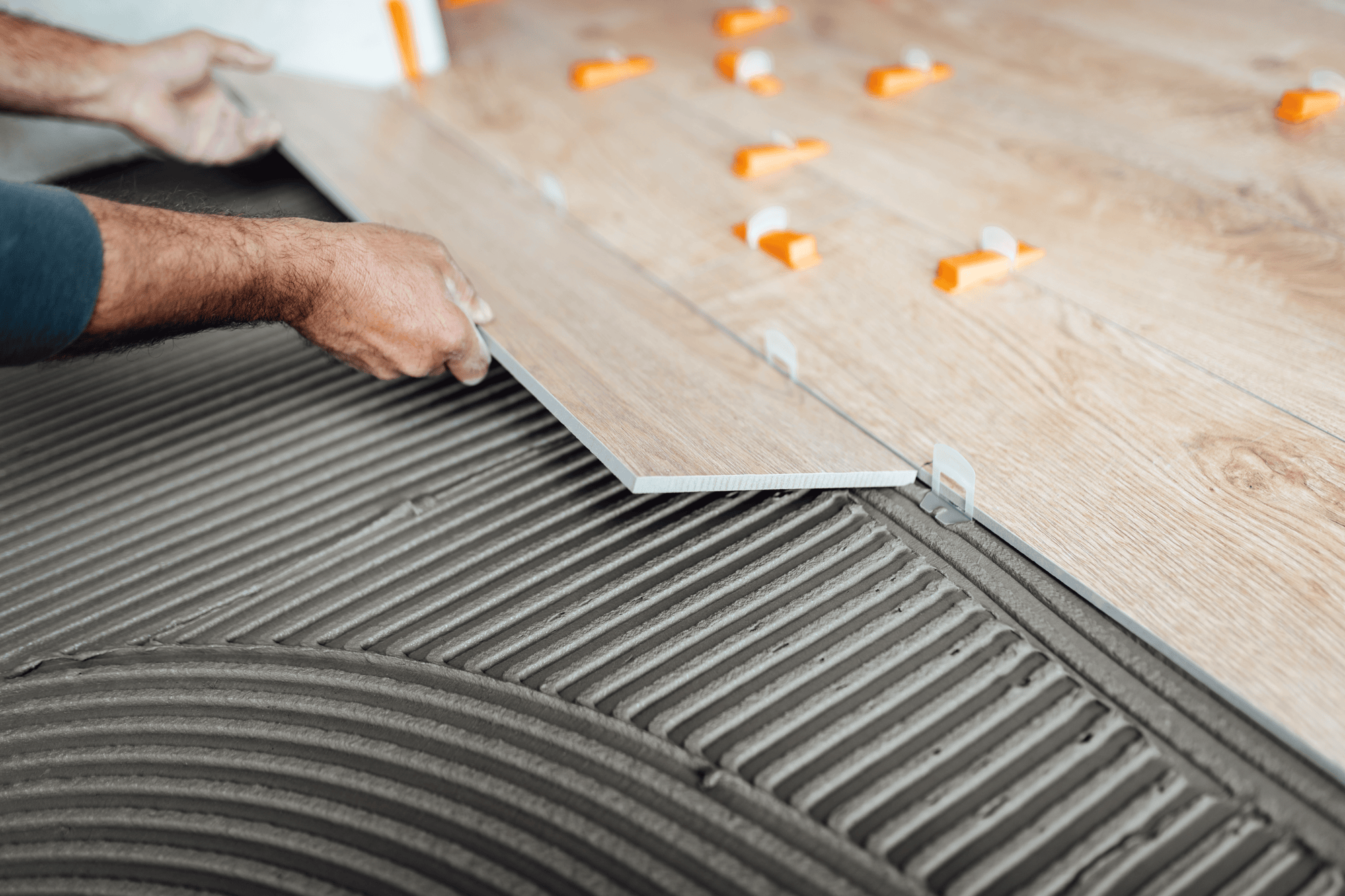
A bag of cement-based adhesive holds a mix of cement, polymers, fine grit and other additives. Your tiler spreads it on the wall or floor with a notched trowel and presses each tile into it. The short code on the bag tells you which tiles and places that grade is made for.
WHAT TILE ADHESIVE DOES
Depending on the grade, it can grip plaster, concrete, block walls, cement screed (the smooth cement layer on a floor) or even old tiles.
Some grades are made for dry rooms indoors. Others are made for washrooms, outside walls or extra-large tiles, and one kind bonds tiles to wood, metal or glass.
There's no single best tile adhesive for every job. The right one is the grade made for your tile, your surface and your room.
WHY A POOR MATCH LEADS TO HOLLOW TILES
Tiles differ in weight, in how much water they soak up, and in the surface on their back. An adhesive made for one kind of tile can bond weakly to another.
Poor coverage leaves air gaps under a tile, and you hear them later as a hollow sound when you tap it. In time, a badly fixed tile can come loose from the wall or floor.
Hollow tiles are an installation fault: the wrong grade, or adhesive mixed or spread badly. So the right grade also has to be mixed and spread properly.
THE CODE ON THE BAG: YOUR QUICK CHECK
The code tells you what kind of adhesive is in the bag and what it can do:
- C means cement-based. C1 is the basic grade, and C2 is an improved grade that grips harder.
- R means a reaction resin adhesive, such as a two-part polyurethane (PU), that sets by a chemical reaction.
- T means reduced slip. Tiles stay where you press them on a wall while the adhesive sets.
- E means extended open time. That's how long you have to place a tile before the spread adhesive starts to skin over. SEF 666, SEF 666 Plus and SEF 777 give you 30 minutes.
- S1 and S2 mean the adhesive can flex a little when the surface moves with heat or with the building. S2 flexes more.
So a bag marked C2TE is a stronger cement-based grade that holds tiles on a wall and gives you extra working time.
Some bags also show a Type number from IS 15477, the Indian Standard for tile adhesives. If you see one, make sure the bag still lists your tile, surface and room, or ask your dealer what the Type covers.
The letters you need depend on four things: your tile, whether it goes on a wall or floor, the room, and the tile size.
HOW TO CHOOSE ADHESIVE FOR TILES: FOUR THINGS TO MATCH
Start with the tile, which sets the starting grade, then add a T for walls. A wet or outdoor room needs a grade made for water and weather, and a big tile needs extra working time.
CERAMIC, VITRIFIED OR STONE: MATCH THE ADHESIVE TO YOUR TILE
WALL OR FLOOR: WHAT EACH ASKS OF THE ADHESIVE
DRY, WET OR OUTDOOR: MATCH THE ROOM
Your tile box says whether the tiles are ceramic or vitrified. If it doesn't, your dealer can tell you.
Small ceramic and clay tiles are porous, which means they soak up some water. Vitrified tiles soak up less water, so they need an adhesive that grips harder.
A ceramic tile adhesive with a C1T code, such as our SEF 333, is made for small ceramic and clay tiles in dry areas indoors. It can also take small vitrified tiles, and it needs only water for mixing.
For other vitrified tiles, use one of our C2 grades. A vitrified tile adhesive like SEF 444, which is C2T, is made for ceramic and vitrified tiles on indoor walls and floors.
For marble, granite and other natural stone, use one of our C2 grades as well. Indoors, SEF 444 takes stone and glass mosaic tiles, and SEF 666 or SEF 666 Plus take large stone tiles. On outside walls, use SEF 777 or SEF 888.
A tile adhesive for wall tiles needs a T in its code, so tiles don't slide down while it sets. Your tiler can then lay row after row up the wall without the lower rows moving. Every cement-based SEF grade carries a T, and SEF 777 supports tiling up to 6 m high.
Floors need full cover under each tile. Gaps left underneath turn into that hollow sound when you walk on the tile. Before you buy a tile adhesive for floor tiles, make sure the bag says it's for floors.
Some grades list both. SEF 333 and SEF 444 are made for wall and floor tiling, and SEF 666 covers walls and floors too. SEF 888 is listed for outside walls, facades, pools and fountains, so check the bag before using it on a floor.
On a floor, the setting time decides when you can use the room again. SEF 444 is ready for light foot traffic and grouting within 24 hours.
Wet rooms and outdoor spots need a stronger, more flexible grade than dry indoor rooms:
- Dry rooms indoors, such as bedrooms and living rooms, can take any grade that suits the tile, from C1T up.
- Semi-wet spots indoors, such as a kitchen wall that gets splashed, suit SEF 444, which is made for dry and semi-wet areas.
- Wet and submerged areas, such as washrooms and swimming pools, need SEF 777, a C2TES1 grade made for them.
- Balconies, terraces and outside walls suit SEF 777, and SEF 888 suits facades and cladding.
TILE SIZE: BIGGER TILES NEED MORE GRIP AND TIME
Large tiles need a C2 grade with an E, and extra-large ones need a flexible grade as well.
An E grade gives you more time to place each tile, which helps when adhesive is spread over a wide area. SEF 666 and SEF 666 Plus are C2TE grades that hold tiles up to 1200 x 1800 mm with minimal slipping.
For extra-large tiles and slabs, look for S1 or S2 in the code. SEF 888 Grande is a C2TES2 grade made for extra-large tiles and stone on surfaces that move or vibrate, such as high-rise buildings.
TILE ADHESIVE GRADES COMPARED AT A GLANCE
Dry and semi-wet indoor jobs use SEF 333 or SEF 444. Wet, outdoor and large-tile jobs need grades with E, S1 or S2 in the code.
Your job | Code on the bag | Grade to pick | Watch out for |
Small ceramic tiles on dry indoor walls and floors | C1T | SEF 333 | Made for dry indoor areas only, so keep it out of washrooms and outdoors |
Ceramic or vitrified tiles indoors, and new tiles over old ones | C2T | SEF 444 | For dry and semi-wet indoor areas; clean and degrease old tiles first |
Large tiles up to 1200 x 1800 mm, marble and granite, inside | C2TE | SEF 666 or SEF 666 Plus | Gives a 30-minute open time, so spread only what you can tile in that time |
Washrooms, swimming pools, balconies, terraces and outside walls | C2TES1 | SEF 777 | In wet areas, seal joints with epoxy grout to stop seepage |
Large tiles and stone on outside walls, façades, pools and fountains | C2TES1 | SEF 888 | Listed for walls and façades; check the bag before using it on a floor |
Extra-large tiles and slabs on surfaces that move or vibrate | C2TES2 | SEF 888 Grande | Leave slab laying to a tiler |
Tiles on wood, metal, glass, gypsum board or fibre cement board | R2, a two-part resin | PU Adhesive | Two-part mix; follow the label and wear gloves |
TIPS FOR CHOOSING TILE ADHESIVE AT THE SHOP
- Carry your tile details with you: ceramic or vitrified, the size and the colour. Our adhesive selector asks for these, plus the surface, the area and what's underneath, and suggests a grade.
- Read the whole code, and check that the bag lists your surface (wall, floor or both) and your area.
- If your tiler wants the technical details, download the product files for your grade before buying.
MISTAKES TO AVOID WHEN CHOOSING AND USING TILE ADHESIVE
- Don't pick a bag on price or habit alone. A grade made for a different tile or room can bond weakly.
- Never add extra water to make the mix spread more easily, or to adhesive that has started to set. It weakens the bond, so mix exactly as the bag says.
- Avoid spreading adhesive over a large area at once. Once it skins over, tiles pressed into it won't grip, so spread only what you can tile within the open time.
- Don't use SEF 333 in a washroom or outdoors. It's made for dry indoor areas only.
- Don't tile over a dusty, damp or uneven surface. It should be clean, firm and level, because adhesive spread over dust sticks to the dust and leaves the tile weakly fixed.
- Don't use one grade for the whole house without checking each room. A bedroom, a bathroom and a terrace each bring their own mix of water, weather and tile size.
WHICH TILE ADHESIVE SUITS EACH ROOM AND JOB
Bedrooms and living rooms can take a standard indoor grade chosen by the tile. Bathrooms, balconies and outside walls need a grade made for water and weather, and a few jobs need a special grade or a tiler.
KITCHEN AND BATHROOM WALLS
BATHROOM FLOORS AND OTHER WET AREAS
LIVING ROOM AND BEDROOM FLOORS
LAYING NEW TILES OVER OLD ONES
BALCONIES, TERRACES AND OUTSIDE WALLS
PLYWOOD, METAL, GLASS AND GYPSUM BOARD
For ceramic or vitrified tiles on indoor walls that only get splashed, SEF 444 suits dry and semi-wet areas. Inside a shower area, where the wall gets soaked every day, move up to SEF 777, which is made for wet areas such as washrooms.
Bathroom floors need a polymer-modified adhesive, one with polymers mixed into the cement, and epoxy grout in the joints to stop seepage. Away from the shower, SEF 444 suits a floor that only gets wet now and then. It can go over a waterproofing membrane, the waterproof layer laid under tiles in wet areas.
In the shower area, use SEF 777, which is made for wet and submerged areas. The same grade suits swimming pools.
These rooms stay dry, so the tile decides the grade. Small ceramic floor tiles can go down with SEF 333.
Vitrified floor tiles suit SEF 444. For large-format floor tiles, SEF 666, a C2TE grade, gives you longer to lay each tile.
You can lay new tiles over old ones with SEF 444, a polymer-modified adhesive approved for tile-on-tile work. Clean the old tiles and degrease them, which means washing off any oil and grease, so the adhesive can grip.
Tap the old tiles before you start. Have any that sound hollow or feel loose fixed first, because the surface underneath has to be firm.
Outdoor tiles take sun, rain and heat, and outside walls need a deformable grade, one that can flex a little. SEF 777 suits balconies, terraces and outside walls with large tiles or natural stone. For façades and cladding, SEF 888 is made for exterior walls.
Cement-based grades are made for surfaces like plaster, concrete and cement screed. For wood, metal, glass, gypsum board or fibre cement board, use our PU Adhesive.
It's a two-part polyurethane mix that sets by a chemical reaction, and it also suits wet spots such as pools and spas. Mix the two parts exactly as the label says, wear gloves, and keep the room aired while you work.
CHECKS BEFORE YOU BUY TILE ADHESIVE
Once you know the grade, check four things on the bag before you pay:
- the code and product name match the grade you picked
- the bag lists your surface and your area
- it's the grey or white version you wanted
- the bag size suits the amount you need
You can read about our tile adhesive online, then find a dealer near you through our store locator to buy the bags.
WHEN TO BRING IN A TILER
Get a tiler involved, and ask them to confirm the grade, when:
- the surface is damp, dusty, cracked or uneven, since it has to be clean, firm and level before tiling
- the wall or floor moves or vibrates, such as in a high-rise building
- the old tiles you plan to cover sound hollow when you tap them
- you're laying slabs or extra-large tiles, which need a flexible grade, full coverage and back-buttering where the bag calls for it
HOW TILE SIZE, HEAT, COLOUR AND QUANTITY CHANGE WHAT YOU BUY - H2
Slabs and large tiles also change how much adhesive you buy. Hot weather and heated floors change the grade, tile colour decides grey or white, and the area sets the number of bags.
i). LARGE TILES AND SLABS
Where the bag calls for it, the back of each large tile gets a coat of adhesive too, which tilers call back-buttering. Allow extra adhesive for this when you buy.
ii). HOT WEATHER, SUN AND HEATED FLOORS
In hot weather, SEF 666 and its 30-minute open time give your tiler longer before the adhesive skins over.
For floors with underfloor heating, and for balconies and terraces, SEF 777 is made to handle heat and movement. For extra-large tiles in kitchens and sunny outdoor spots, SEF 888 Grande is made to withstand high temperatures.
iii). GREY OR WHITE ADHESIVE
Each SEF grade comes in grey and in white, for example SEF 444 and SEF 444 WHITE. For glass or light-coloured mosaics, use white adhesive so the colour of the bed doesn't show through. Tile colour is also one of the six questions in the adhesive selector, so tell it, or your dealer, what shade your tiles are.
WHAT DECIDES THE TILE ADHESIVE PRICE
What you spend depends on the grade, the bag size, the colour version and how many bags your area needs. Cement-based grades come in 20 kg and 40 kg bags, while the PU Adhesive comes in 4 kg and 8 kg packs.
Measure your area, then check the bag for a coverage figure, or ask your dealer, to work out how many bags you need. With the grade, colour and bag count settled, your dealer can give you the current price.
Key Takeaways
- Read the code on the bag and match it to your tile, surface, room and tile size.
- A poor match, or extra water in the mix, can leave tiles hollow or loose later.
- Small ceramic or vitrified tiles in dry indoor rooms can take C1T, and other vitrified tiles need one of our C2 grades.
- Wall tiles need a T in the code, so they stay in place while the adhesive sets.
- For outside walls, washrooms and pools, pick a flexible grade such as our C2TES1 SEF 777, with epoxy grout in wet-area joints.
- Big indoor tiles need an E grade, and slabs on moving surfaces need a flexible C2TES2 grade.
- Call a tiler for slabs, surfaces that move or are damp, and old tiles that sound hollow.
- Grade, bag size, colour and area decide the tile adhesive price, so confirm it with your dealer.
Conclusion
Choosing the right adhesive for tiles comes down to one code and four questions. Check what the tile is, whether it goes on a wall or floor, how wet the room gets and how big the tile is. Then the code on the bag tells you whether a grade fits your job.
Even the right grade needs a clean, firm surface under it, a mix made exactly as the bag says, and adhesive spread in small sections. For slabs, surfaces that move, or old tiles that sound hollow, bring in a tiler before you buy anything.
Put your tile type, size, colour and room into our adhesive selector to get a suggested grade, then take that grade to your dealer.
FAQs About Tile Adhesive for Wall & Floor
Q. Which tile adhesive is best for vitrified floor tiles?
Indoors, a C2T grade such as our SEF 444 handles vitrified floor tiles in dry and semi-wet rooms, and you can walk lightly on the floor within 24 hours. Big vitrified tiles, up to 1200 x 1800 mm, suit a C2TE grade like SEF 666. In a shower area or any floor that stays wet, go for SEF 777.
Q. Can the same tile adhesive be used on walls and floors?
Yes, as long as the bag lists both wall and floor tiling, as SEF 333, SEF 444 and SEF 666 do. A grade used on a wall should have a T in its code. Check the bag every time, because some grades, like SEF 888, are listed for outside walls, façades and pools.
Q. Can new tiles be laid over old tiles with adhesive?
Yes. Use a grade approved for tile-on-tile work, like SEF 444, and wash the old tiles free of grease and dirt before you start. The old layer has to be solid, so any tiles that feel loose or sound hollow need fixing first. If a lot of them do, get a tiler to look at the floor.
Q. How long should tile adhesive dry before grouting?
Check the bag, since each grade sets at its own pace. With SEF 444 you can grout within 24 hours. Wait until the tiles are firm and the adhesive is fully dry, because grouting too early disturbs tiles that haven't set. Keep water off the area until the adhesive has cured.
Q. How much tile adhesive do I need per square foot?
It depends on the grade, the tile size and the trowel your tiler uses. Check the bag for a coverage figure, or ask your dealer. Measure your area in the same unit, then divide by that coverage to get the number of bags. Large tiles that get back-buttered use extra adhesive, so allow for that.
Q. Is tile adhesive waterproof?
No. Tile adhesive holds the tiles in place. A wet-area grade like SEF 777 is made to keep holding in washrooms and swimming pools.
Keeping water out takes a waterproofing membrane under the tiles in wet areas, plus joints sealed with epoxy grout. Grout on its own won't stop water. Grades like SEF 444 can go on top of the membrane.
Q. Can tile adhesive be used on plywood, metal or glass?
Yes, with a two-part polyurethane adhesive. Our PU Adhesive is made to bond tiles to wood, metal, glass, gypsum board and fibre cement board, and it sets by a chemical reaction. It comes in 4 kg and 8 kg packs. The cement-based SEF grades are made for surfaces like plaster, concrete and cement screed.
Q. What do C1, C2, T and E mean on a tile adhesive bag?
C tells you it's a cement-based adhesive, and the number after it is the grade: 1 is basic, and 2 grips harder. T stops tiles sliding down a wall while the adhesive sets.
E gives you more time to place each tile, which is 30 minutes on SEF 666, SEF 666 Plus and SEF 777. S1 or S2 at the end means the adhesive can flex, and S2 flexes more.
Q. What is the tile adhesive price for a 20 kg bag?
Prices change with the grade and with grey or white, so your dealer gives the current figure. Our cement-based grades come in 20 kg and 40 kg bags. To work out how many bags you need, check the bag for a coverage figure or ask your dealer. You can also book a call or chat with us about pricing.
Q. Where can I buy tile adhesive?
You can buy it from a dealer near you. Our store locator lists our building solutions dealers. Before you go, you can read about each grade online and download its product files, or book a call or chat with us about choosing a grade and its price.
Q. Which tile adhesive should I use for bathroom and shower walls?
Use SEF 444 on walls that only get splashed, since it's made for dry and semi-wet spots indoors. On walls inside the shower, which get soaked every day, use SEF 777, a grade made for wet and submerged areas. Seal the shower joints with epoxy grout to stop seepage.