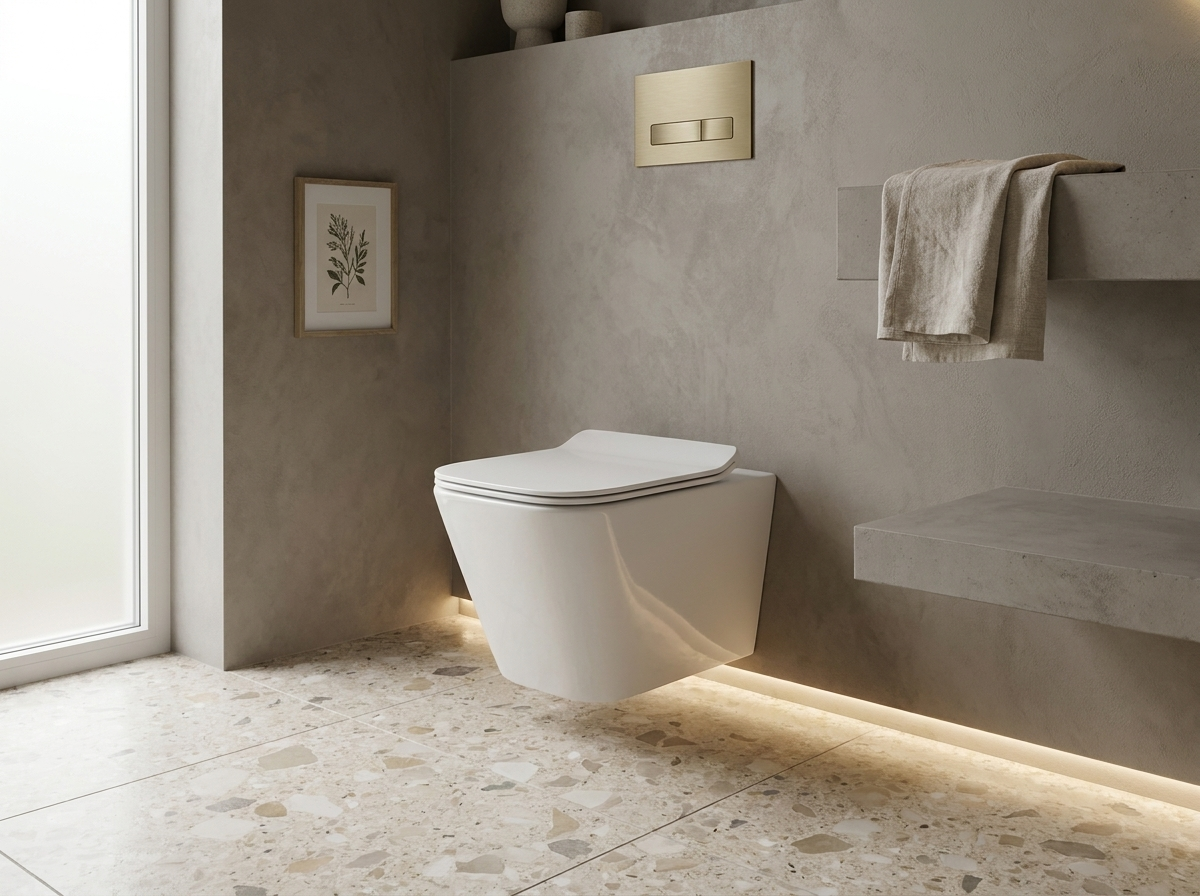
Quick Answer: Rimless toilets have no overhanging rim around the top of the bowl. That leaves no hidden ledge under the edge, and you can reach the whole bowl when you clean it. To choose one, check the flush system and its litres, the seat cover, whether it's floor-mounted or wall-hung, and the trap. Rimless alone doesn't make a toilet germ-free, splash-free or water-saving, so check those details on the model. If your drain doesn't match the trap, ask your plumber to measure it and choose a matching model before you buy.
When choosing a toilet for your bathroom, hygiene, ease of cleaning and flushing performance are just as important as design. One innovation that brings these elements together is the rimless toilet.
Unlike conventional toilets, which feature a concealed rim around the inner edge of the bowl, rimless toilets have an open bowl design that eliminates this hard-to-reach area. Combined with specially engineered flushing technology, they offer a more accessible, easy-to-clean and contemporary bathroom solution.
But what exactly is a rimless toilet? How does it work? And is it really better than a conventional toilet?
Here are the answers to some of the most frequently asked questions about rimless toilets.
Key Takeaways
- Rimless toilets have no overhanging rim, so no strip of the bowl stays hidden from you.
- Better access for cleaning is the main benefit, though the bowl still needs a brush and regular cleaning.
- The word rimless doesn't prove fewer germs, less splash or lower water use, so check each model.
- Read the two flush numbers on the box, with the big flush first and the small flush second.
- Floor-mounted toilets need nothing inside the wall, while wall-hung toilets need a frame and hidden tank before tiling.
- An S-trap drains into the floor and a P-trap drains through the wall, so get your drain checked first.
- Call your plumber if water splashes out, the flush seems weak or the cistern keeps running.
- Follow any care note that came with the toilet, and keep acid cleaners off the tiles and grout around it.
What Is a Rimless Toilet?
A rimless toilet is a modern toilet design that does not have the traditional enclosed rim running along the inner edge of the bowl.
In conventional toilets, water flows through a concealed channel beneath the rim and enters the bowl through small openings. These hidden areas can accumulate dirt, limescale and residue over time, making them difficult to clean.
A rimless toilet eliminates this enclosed channel. Instead, it uses a specially designed flushing mechanism to distribute water directly around the inner surface of the bowl.
The result is a more accessible bowl design that is easier to clean and maintain, while offering an improved approach to everyday bathroom hygiene.
Rimless commode meaning, and the other names you'll see
Commode is just another name for the toilet, so a rimless commode is the same product.
Product listings can also say single piece closet or wall hung closet. So a rimless closet is the same product with a trade word on it.
Rimless only describes the shape of the bowl. It doesn't tell you how the toilet is mounted, which way it drains or how many litres it uses. In our range, rimless comes as one-piece floor-mounted toilets, wall-hung toilets and smart toilets, so two rimless models can differ a lot.
To check whether a model is rimless, look for the word Rimless in its listed features. In a showroom, look under the top edge of the bowl for an overhang.
How Does a Rimless Toilet Work?
A rimless toilet works through an engineered water-distribution system that directs flush water around the inner surface of the bowl.
When the flush is activated, water enters the bowl through strategically designed outlets or channels. The bowl's internal geometry guides the water around its surface, helping wash away waste and residue.
Unlike conventional toilets, which depend on a concealed rim to distribute water, rimless toilets use an open design and controlled water flow to achieve effective bowl coverage.
The efficiency of the flush depends on the toilet's ceramic design, water pressure and flushing mechanism.
The rimless flushing system and what it uses
How the water is distributed depends on the design. One design lets water in at the upper back of the bowl and sends it along a shelf before it reaches the lower bowl. So the flush on one rimless model won't necessarily match the flush on another.
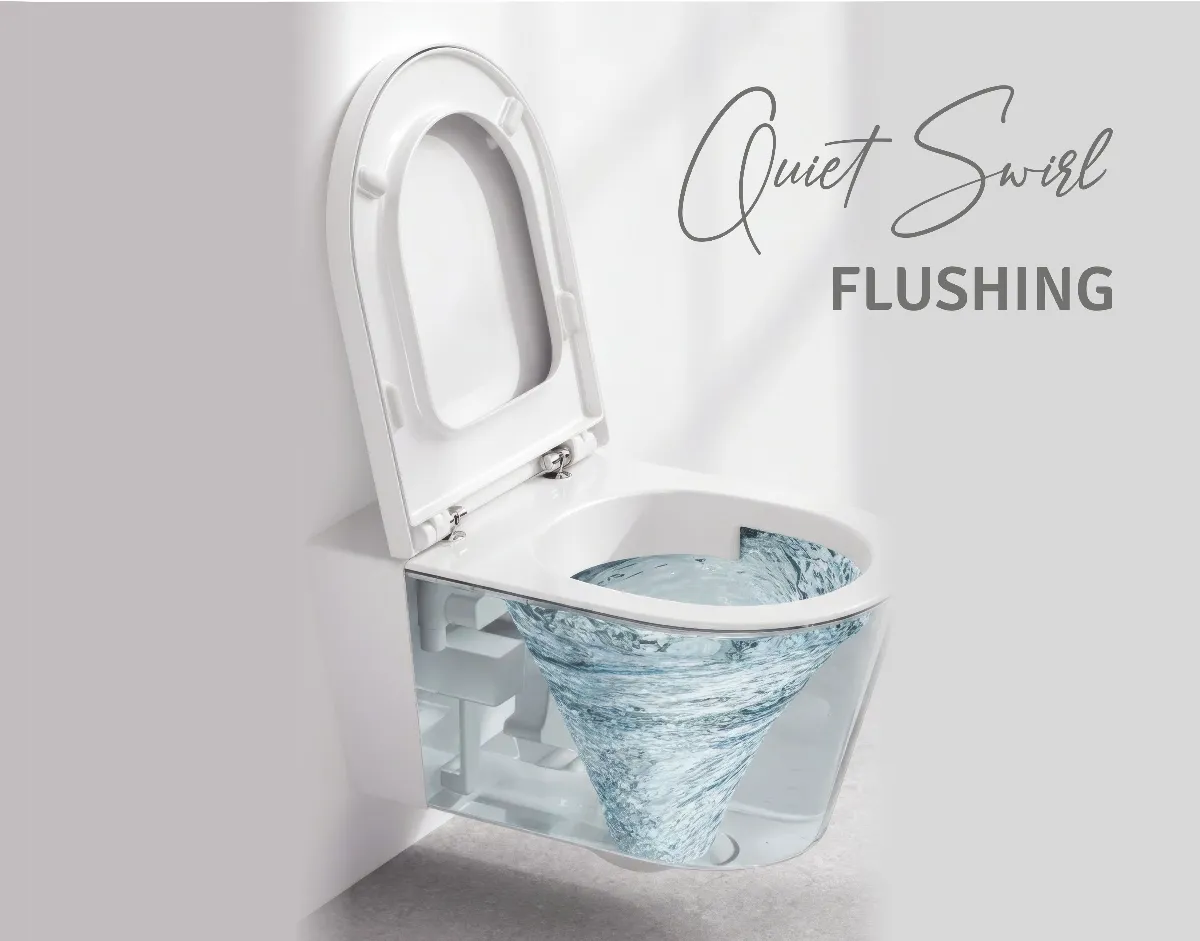
Look for the flush name in the model's features. Our Bellis One Piece lists Syphonic, and our Cubique Wall Hung lists Quiet Swirl, which sends water around the bowl in a 360-degree flow with little noise. If a name is new to you, your dealer can explain it for that model.
What Is the Difference Between a Rimless Toilet and a Regular Toilet?
The primary difference between a rimless toilet and a conventional toilet is the design of the inner bowl and the way flushing water is distributed.
A conventional toilet has an enclosed rim beneath which water flows during flushing. A rimless toilet removes this concealed area and uses a specially engineered flushing system.
Here are the key differences:
| Feature | Conventional Toilet | Rimless Toilet |
|---|---|---|
| Bowl design | Enclosed inner rim | Open, rim-free design |
| Water distribution | Through concealed rim channels | Through engineered water outlets |
| Cleaning | Requires cleaning beneath the rim | Easier access to the entire inner bowl |
| Dirt accumulation | Hidden areas can collect residue | Fewer concealed areas |
| Hygiene maintenance | Requires additional attention to the rim | Easier to maintain |
| Appearance | Traditional bowl design | Clean, contemporary appearance |
The biggest advantage of a rimless toilet is its combination of accessible design and engineered flushing performance.
What Are the Benefits of Rimless Toilets?
Rimless toilets offer several advantages that make them an increasingly popular choice for modern bathrooms.
Let's explore the key benefits.
A. Better Hygiene and Cleanliness
One of the biggest benefits of rimless toilets is their hygienic design.
Conventional toilets have concealed spaces beneath the rim where dirt, bacteria and mineral deposits can accumulate. These areas are often difficult to reach during routine cleaning.
Rimless toilets eliminate this enclosed section, reducing hidden spaces where residue can collect.
Their open bowl design also makes it easier to inspect and clean the entire inner surface, helping maintain better everyday bathroom hygiene.
B. Easier and Faster Cleaning
Cleaning a conventional toilet often involves reaching beneath the rim to remove accumulated dirt and deposits.
With a rimless toilet, there is no enclosed rim to scrub underneath. The accessible bowl design makes routine cleaning simpler and less time-consuming.
You can easily reach the inner surfaces with a toilet brush or cleaning cloth, making regular maintenance more convenient.
For households looking to reduce bathroom cleaning effort, this is a significant advantage.
How to clean a rimless toilet
Best for: anyone who dislikes scrubbing under a rim.
What you need: a toilet brush and the cleaner your dealer suggests for that model.
- Put the cleaner around the inside of the bowl, following the label. Wear gloves and keep the room aired while you use it.
- Brush the whole bowl, including the area just under the top edge.
- Flush, then check that area for anything you missed.
What to expect: you can see the whole bowl and brush it with no overhang in the way. A rimless bowl doesn't clean itself, so it still needs the brush.
C. Efficient and Powerful Flushing
Rimless toilets are designed with specially engineered flushing systems that distribute water around the bowl.
The controlled water flow helps clean the inner surface effectively and remove waste with every flush.
However, flushing performance depends on the quality of the water-distribution system, bowl geometry and water pressure. A well-engineered rimless toilet is designed to deliver thorough bowl coverage without unnecessary water wastage or splashing.
D. Reduced Dirt and Residue Build-Up
The absence of a concealed rim means fewer inaccessible spaces where dirt, limescale and residue can accumulate.
This helps reduce the effort required to maintain the toilet's cleanliness over time.
When combined with a smooth, high-quality ceramic glaze, the open bowl design can further support easier cleaning and maintenance.
E. Contemporary and Minimalist Design
Apart from functionality, rimless toilets also complement modern bathroom aesthetics.
Their clean inner contours and streamlined appearance create a more refined look. Whether installed as a wall-hung toilet, back-to-wall toilet or floor-mounted model, rimless designs fit naturally into contemporary bathroom spaces.
They combine practical functionality with understated design.
Are Rimless Toilets More Hygienic Than Conventional Toilets?
Yes, rimless toilets offer a design advantage when it comes to maintaining hygiene.
The enclosed rim in conventional toilets can create hidden spaces where dirt, bacteria and limescale may accumulate. These areas are difficult to access and require additional cleaning attention.
Flushing doesn't sort this out on a conventional toilet. Doing it again and again doesn't do much to cut bacteria under the rim, and that area is hard to disinfect.
Rimless toilets eliminate this concealed section, making the bowl easier to inspect and clean.
However, it is important to understand that a rimless design does not make a toilet self-cleaning or germ-free. Regular cleaning and proper maintenance are still essential for maintaining bathroom hygiene.
Do Rimless Toilets Save Water?
Rimless toilets can be designed to deliver effective flushing with optimised water consumption.
Their engineered water-distribution systems aim to clean the bowl efficiently, helping manufacturers develop models that balance flushing performance with water usage.
However, being rimless does not automatically mean a toilet consumes less water than a conventional one.
Actual water savings depend on the flush volume, cistern mechanism and overall product engineering.
When purchasing a rimless toilet, check its full-flush and half-flush water consumption to understand its water efficiency.
A two-button toilet shows two numbers on the box. The first number is the big flush in litres, and the second is the small flush.
Common two-button toilets use 6 litres for a full flush and 3 litres for a half flush, so you can compare any model with that. For example, our Optimus Classique Single Piece uses 1.8 litres for the half flush and 4.5 litres for the full flush.
Do Rimless Toilets Cause Water Splashing?
This is one of the common concerns people have when considering a rimless toilet.
Since rimless toilets do not have a conventional enclosed rim, the water flow needs to be carefully controlled to prevent splashing outside the bowl.
Modern rimless toilets address this through specially designed water outlets, bowl contours and flushing mechanisms that guide water around the inner surface.
A well-engineered design ensures effective bowl coverage while minimising splashing.
The quality of the flushing technology is therefore an important factor to consider when choosing a rimless toilet.
A rimless toilet can still splash, so ask your dealer how the model you like controls it. If water splashes out of the bowl after fitting, ask your plumber to check the toilet.
Are Rimless Toilets Suitable for Indian Bathrooms?
Absolutely. Rimless toilets are suitable for Indian homes and contemporary bathroom designs.
They offer practical advantages for households that prioritise hygiene, convenient cleaning and efficient flushing.
They are available in different configurations, including wall-hung, floor-mounted and back-to-wall designs, making them suitable for different bathroom layouts.
However, before purchasing, it is important to consider water pressure, plumbing compatibility, installation requirements and the flushing performance of the chosen model.
If the rimless model you like is tankless, it flushes on direct pipe pressure, with no cistern. Before you choose it, ask a plumber to check your water pressure against its fitting instructions.
What Are the Different Types of Rimless Toilets?
Rimless technology can be incorporated into different toilet configurations depending on the bathroom layout and design preference.
Wall-Hung Rimless Toilets
Wall-hung rimless toilets are mounted on the wall, with the cistern concealed behind it. They create a floating appearance, free up visible floor space and make cleaning underneath the toilet easier.
Wall-hung toilets keep the tank inside the wall, behind a frame, so the floor underneath stays open. You can run a mop straight underneath and clean the whole floor in one go. It saves floor space, as long as your wall has room for the frame.
The trade-off is the work behind the wall. The job can need more than one tradesperson, and replacing the hidden tank or frame can mean cutting into the wall.
If you're leaning towards wall-hung, follow this order:
- Have your plumber check whether your wall can be opened and has room for the frame and hidden tank.
- Get the plumber to check where the frame fixes, since it carries the bowl and the person using it.
- Fix the frame and cistern before anyone tiles that wall.
Floor-Mounted Rimless Toilets
These toilets are installed directly on the bathroom floor. They offer the benefits of rimless bowl technology while retaining a conventional floor-mounted installation.
A floor-mounted toilet needs nothing inside the wall. Its tank sits in the room, so it's easy to reach, and it has fewer parts and no wall work. That suits a tight budget, though you have to mop around the base and reach into the gap behind it.
Back-to-Wall Rimless Toilets
Back-to-wall toilets sit close to the wall, concealing much of the plumbing and creating a neat, streamlined appearance. They are a suitable option for bathrooms that favour a clean, uncluttered look.
Smart Rimless Toilets
If you want wash modes and a heated seat, look at the Smartsense Pro, which also lists UV sterilisation and Warm Drying. Check what power and water connections it needs, so they're planned before the fitting.
Rimless toilet features compared: what each one suits
This table shows which bathroom each of these four rimless options suits.
| Rimless option | Listed example | What to check on the listing | Best for | Watch out for |
|---|---|---|---|---|
| One-piece, floor drain | Optimus Neo Rimless | S-220 trap, Ezee Close | Swapping a floor-mounted toilet whose drain goes down into the floor | You still mop around the base and reach into the gap behind it |
| One-piece, wall-drain option | Optimus Classique Rimless | P-180, S-300 and S-220 traps listed | A drain that comes out through the wall behind the toilet | Confirm with the dealer which trap you can get |
| Wall-hung | Cubique Wall Hung | Quiet Swirl, Ezee Close, UF Seat Cover | A renovation where you want to mop straight under the toilet | A frame and hidden tank go in before tiling, and not every wall can take a frame |
| Smart toilet | Smartsense Pro | Multiple Wash Modes, Seat Heating, Warm Drying, UV sterilisation | Someone who wants wash modes and a heated seat | Ask the dealer about power and water supply, because the listing doesn't show them |
The trap and your drain
The trap is the curved channel at the base of the bowl that carries the waste away. An S-trap toilet drains down into the floor, and a P-trap toilet drains out through the wall behind it.
- Check your old toilet's outlet to see whether it goes into the floor or the wall.
- Ask your plumber to check where your drain comes out and how far it sits from the wall. For a wall outlet, note how high it is too.
- Show those details to the dealer and match them to the trap size on the listing, such as S-220, S-300 or P-180.
- Confirm the exact trap before you pay, because some listings show more than one size.
When the trap matches, the toilet lines up with the drain you already have. If no model matches, tell your dealer and plumber before you buy anything.
What Should You Consider Before Buying a Rimless Toilet?
While rimless toilets offer several advantages, choosing the right model is important to get the best experience.
Here are five things to consider:
- Flushing performance: Look for a well-engineered flushing mechanism that provides effective water distribution and thorough bowl coverage.
- Splash control: Check whether the design controls water flow effectively and minimises splashing.
- Water consumption: Compare full-flush and half-flush water usage before making a decision.
- Ceramic quality: Choose a toilet with a smooth, durable ceramic surface that is easy to clean and maintain.
- Installation compatibility: Ensure the toilet is compatible with your bathroom layout, drainage connection, cistern and available water pressure. Check the trap too: an S-trap drains into the floor and a P-trap drains through the wall, so ask your plumber to confirm where your drain comes out before you buy.
Rimless toilet seat: what you're actually choosing
Rimless describes the bowl, and the seat cover is a separate part that sits on top of it. Some shop listings say "toilet seat" when they mean the whole toilet, so check what's actually included.
Listings can also name seat cover features. The Cubique, Swiss, Denise and Bellis models all list a UF Seat Cover and Ezee Close, so ask your dealer what these mean on your model. Try closing the seat in the shop, because you'll use it every day. A soft-close seat cover stops the seat being slammed or dropped, which is handy in a busy family bathroom.
Also Read: Best toilets for Indian homes with water-saving features
Choosing a rimless toilet is not just about selecting a modern design. It is about finding the right balance between hygiene, functionality, durability and everyday convenience.
When to stop and call for help
If no model matches your drain, ask your plumber whether the outlet can be changed before you buy. Don't try to force a toilet onto a drain it wasn't made for.
Before the plumber leaves, flush a few times and look around the base and the cistern for leaks. Then stop and call your plumber if any of these happen after fitting:
- Water splashes out of the bowl when you flush.
- The flush seems weak or the bowl doesn't clear.
- The cistern keeps running. Get it fixed straight away, because it lets water flow away all day.
- The toilet rocks, or water leaks around the base.
Don't keep using a toilet that leaks. If the plumber can't sort it out, go back to your dealer.
Looking after a rimless toilet
Follow any care note that came with the toilet. If you're not sure about a cleaner, ask your dealer before you use it.
Each of our toilets is fired at extreme temperatures to get near-zero porosity, meaning almost no tiny pores, and that helps it resist stains. That doesn't make it stain-proof, so keep up the regular cleaning.
If you see marks from hard water, ask your dealer which cleaner suits that model.
Don't use vinegar, lemon or other acid cleaners on the tiles and grout around the toilet, because acids can wear away the glaze on vitrified tiles.
Help keep the toilet from clogging by flushing only toilet paper and human waste. Keep sanitary products, wipes and paper towels out of the bowl.
How the floor tiles change grip
The bathroom floor gets wet, so the tile around your new toilet needs grip as well. Our Slip Shield tiles are rated R10 to R11 for slip resistance, and R11 offers more traction than R10. They come in ceramic and in our Duragres vitrified tiles.
If you're changing the tiles at the same time, plan them together with the toilet, so the frame and cistern go in before tiling.
Conclusion
Keep a brush next to the toilet, and clean it regularly. When you're ready, use our store locator to find a dealer near you, or visit one of our experience centres with your plumber's measurements in hand.
A better bathroom begins with better design, and sometimes, the biggest improvements come from rethinking the smallest details.
FAQs
Q. Are Rimless Toilets Worth Buying?
Yes. Rimless toilets are worth considering if you want a bathroom fixture that combines easier cleaning, improved accessibility and modern flushing technology.
Their biggest advantage lies in eliminating the concealed rim, making everyday maintenance simpler and reducing the spaces where dirt and residue can accumulate.
However, the overall experience depends on the quality of the flushing mechanism, ceramic design and installation.
For homeowners planning a new bathroom or renovating an existing one, a well-designed rimless toilet can be a practical and worthwhile upgrade.
Q. What Is the Future of Toilet Design?
Bathroom design is evolving beyond aesthetics. Today, homeowners are looking for products that make everyday routines more hygienic, convenient and comfortable.
Rimless toilets represent this shift by combining thoughtful ceramic engineering with improved flushing mechanisms and accessible designs.
As bathroom technology continues to evolve, innovations in flushing performance, water efficiency, hygiene and ease of maintenance will play an increasingly important role in shaping the toilets of tomorrow.
Q. What are the disadvantages of rimless toilets?
A rimless toilet can still splash, the flush depends on the model, and the bowl still needs brushing. Wall-hung versions also add wall work, and the hidden parts can be awkward to reach for repairs.
Ask the dealer how that model controls splash, and how the hidden parts are reached.
Q. How much does a rimless toilet cost?
There's no single figure, because the price depends on the model, its features and the fitting work. Floor-mounted toilets suit a tight budget, because they have fewer parts and need no wall work.
A wall-hung toilet adds a frame, a hidden tank and wall work. Ask a dealer for a fitted price on the model you like, with every part and trade included.