Quick Answer
A good pooja room tiles design pairs calm, easy-to-clean walls with a floor that keeps its grip. For the walls, start with a soft neutral, marble, stone or wood look, or one large slab. Then add one feature behind the mandir: a highlighter tile, a carved surface, a mosaic frame or gold accents. On the floor, choose a matt or slightly textured tile, and an anti-skid one if water is used in your rituals. Matt tiles grip better, so keep glossy tiles for the walls. Use epoxy grout around the diya, where oil and ghee land.
Introduction
Pooja room tiles cover the walls and floor of the place where your family prays. That might be a full room or a corner mandir. The tiles set the mood of the space, and they also have to cope with diya soot, oil, ghee, kumkum and sometimes water.
Below, we start with what a pooja room asks of its tiles. Then we go through design ideas for the walls, the wall behind the mandir and the floor. After that, we look at different home setups, and at how finish, size and grout change your choice.
Key Takeaways
- Pooja room tiles need to look calm and resist oil, ghee, kumkum and diya soot.
- Before choosing, check whether water will land on the floor and where the diya will sit.
- Give the walls a calm base: a soft neutral, marble, stone or wood look, or one large slab.
- Pick one feature for the wall behind the idols: a highlighter tile, carved surface, mosaic frame or gold accents.
- Choose a matt, textured or anti-skid floor tile, and keep glossy or polished tiles on the walls.
- Check each tile is approved for walls or floors before you order.
- Use epoxy grout around the diya, keep spares from one batch, and leave slabs to a tiler.
What a pooja room asks of its tiles
Your pooja room's tiles have two jobs: setting a peaceful mood and wiping clean after daily puja. Plan any tiles design around those two jobs first, so the look and the daily cleaning both work.
What the walls and floor have to cope with
The mess in a pooja room lands in a few places. Soot from the diya can mark the wall behind it. Ghee and oil can drip onto the shelf and the floor in front, and kumkum, turmeric and flowers fall wherever you stand to pray.
So the tiles near the diya need a face that resists stains from oil and flowers, and the grout between them has to resist stains too. Glazed and vitrified tiles are easy to clean, which keeps the room looking neat through daily puja and festivals.
If your rituals involve water, the floor gets wet as well. A wet floor needs a tile with grip, so the floor tile has a different job from the wall tile.
The look a pooja room needs
The walls set the mood of the room. Soft neutral colours, marble looks and gentle stone textures help the space feel sacred without clutter. Your tiles should also sit well with the wood, brass and marble already there, such as a wooden mandir unit or brass lamps.
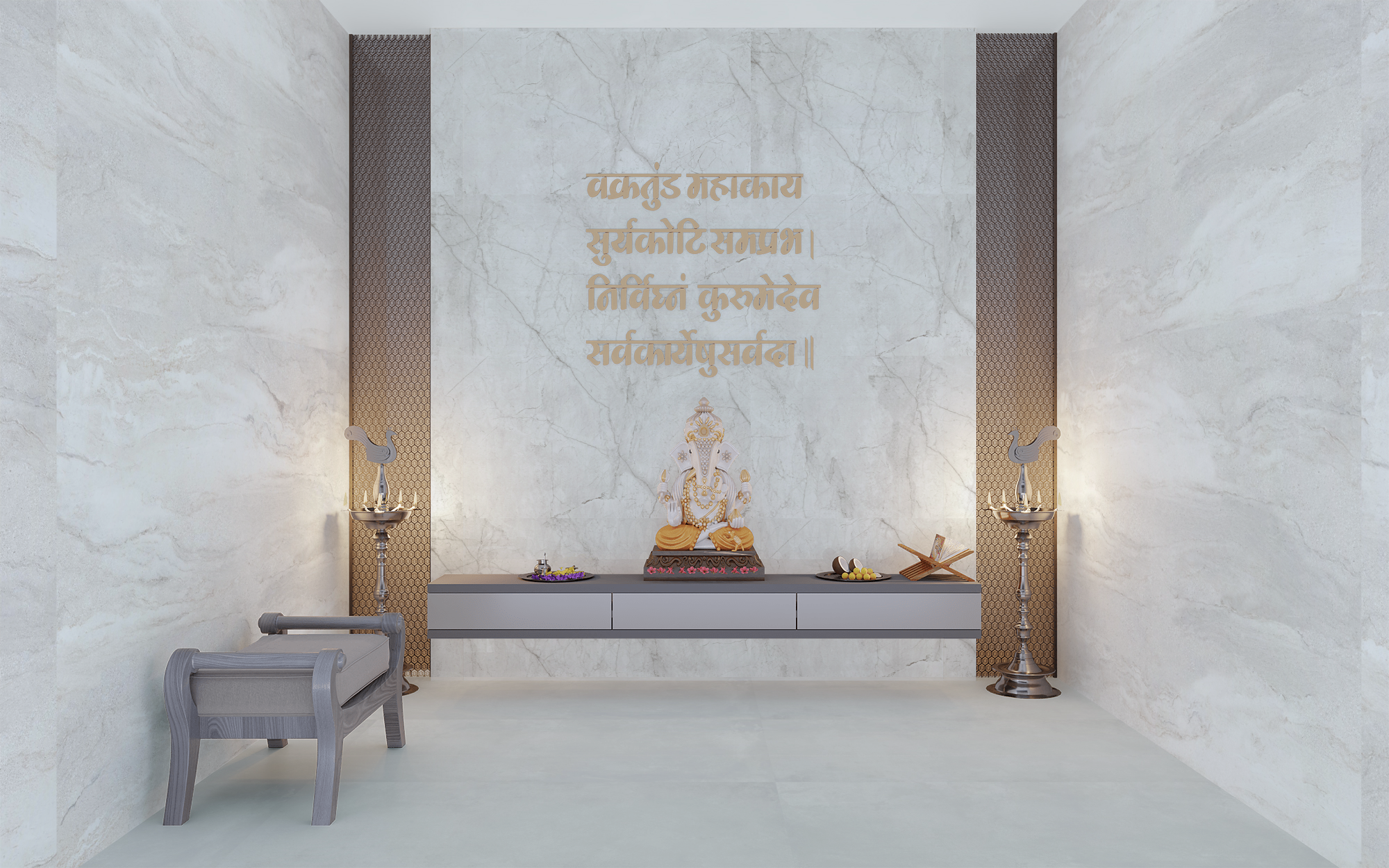
A modern pooja room tiles design can keep most walls plain and put the detail on the back wall. That gives the idols one clear backdrop to stand against.
A quick check before you choose
Answer two questions before you pick a design:
- Will water be used on this floor? If yes, plan a floor tile with extra grip.
- Where will the diya sit? Plan stain-resistant epoxy grout on the wall and shelf around it.
Then check that each tile is meant for where it goes. Many decorative ceramic wall tiles are made for walls alone and shouldn't go underfoot.
So plan the two separately: the walls carry the look, and the floor has to keep its grip.
Pooja room wall tiles design: five calm base ideas
The walls need a calm base before anything else, so the idols and the feature tiles can stand out. These first five pooja room tiles design ideas give you that base in five looks: plain, marble, stone, wood and slab.
1. Soft neutral tiles for a calm backdrop
Best for: small rooms, corner mandirs and anyone who wants the idols to stand out.
White, ivory, cream and beige keep the room quiet, so your attention goes to the idols, the flowers and the lamp. White and ivory glossy or satin vitrified tiles are popular choices for pooja room walls.
How to use it:
- Pick one soft shade for the walls.
- Use the same colour family on the floor, in a matt or textured finish.
- Bring in colour through your feature tiles, the flowers or your brass.
The result is a peaceful room that's easy to refresh later. Changing one feature wall doesn't mean changing every tile.
2. Marble-look tiles for a classic white mandir
Best for: families who love the look of a white marble temple.
A marble-look tile gives you the veins and soft shine of marble on a tile surface. Our Duragres glazed vitrified range includes marble-look tiles with rich veining, and Duragres tiles resist stains, moisture and surface wear.
Use a glossy or satin marble look on the walls, where it reflects the lamp light. On the floor, use the matt version of the same look.
You get the look of a marble mandir, on tiles you clean with a mild pH-neutral cleaner and water.
3. Stone-look tiles for an earthy feel
Best for: rooms with wooden or brass décor and a warmer, natural mood.
Earthy beige and brown stone looks give the room a warm, natural feel. For a modern, minimal room, choose a soft grey stone look with less pattern.
Use a smooth stone look on the walls, or a lightly textured one on the floor for grip. Textured finishes hold dust, so sweep a textured floor regularly and brush a textured wall now and then with a soft, dry brush.
4. Wood-look tiles for warmth
Best for: rooms with a wooden mandir unit, or anyone who wants a warm feel.
Wood-look tiles give you the grain and warm colour of timber on a tile. Our Ceramic Wood Essentia collection comes in 200x1200 mm and 200x1000 mm planks for floors and walls, in matt, satin matt and full polished finishes.
Use the matt planks on the floor, or run them up one side wall to frame the mandir unit. The room feels warm like wood, and you still sweep and mop it like any other tile.
5. One large slab for a back wall with few joints
Best for: a separate pooja room or one wide wall.
A slab is a tile in an extra-large size. Our Coverstone slabs come in sizes such as 800x2400 mm and 1200x1800 mm, and they're made for walls, floors and countertops. Fewer grout lines make a wall look like one continuous surface, and there are fewer joints to keep clean.
Large tiles fixed high on a wall need a fixing system matched to their weight and size. Leave this one to a tiler.
A slab gives you a calm backdrop with only a few lines, and it suits a marble look or a soft neutral. With the main walls this calm, the wall behind the mandir is free to carry one feature.
Four feature ideas for the wall behind the mandir
A feature tile on this wall gives the idols a frame, so it's the place for pattern, shine or colour. Pick one of these four ideas for it and keep the rest of the room plain.
6. A highlighter tile behind the idols
Best for: any mandir, from a wall unit to a full room, and families who want a pattern or motif.
Highlighter tiles are decorative tiles made for the back wall. Ours come with matching floor tiles, so the wall and floor look planned together. A highlighter can carry a floral or checker pattern, or a plain band of a stronger colour. If your family wants a symbol such as Om, this is the spot for it too.
- Choose a motif or pattern your family likes for the area right behind the idols.
- Tile the side walls in a plain tile in a matching shade.
- Lay the matching floor tile from the same range.
This gives you one clear focal point that looks like it was planned along with the floor.
7. A carved or 3D surface for texture
Best for: rooms where you want a pattern without strong colour.
Carved tiles, also called 3D tiles, have a raised or cut-in pattern you can see and feel. Matt carving is one of the finishes you can choose for pooja room walls, so you can have texture in a soft white or beige.
Carved grooves hold dust, like any textured finish. Dust the wall now and then with a soft, dry brush, so soot doesn't build up in the grooves.
8. A mosaic frame around the deity niche
Best for: a niche, an arch or a small wall mandir.
Mosaics are small tile pieces set on a grid sheet. Our Italmarmi mosaics can frame the deity niche, and they come in grid sheets such as 300x300 mm.
- Tile the wall around the niche in a plain tile.
- Run a mosaic border around the edge of the niche, or line the back of it.
- Use epoxy grout if the diya sits inside or near the niche.
A mosaic has lots of small joints. Epoxy grout resists stains, so it helps keep those joints clean around oil and ghee.
9. Gold accents for a festive look
Best for: families who want the mandir to feel festive all year.
A gold border or a few gold-accent tiles around the idols add shine without covering the whole wall.
Keep the gold to that one wall, so the room doesn't get too busy next to your brass lamps. Follow the care advice for that exact tile, and wipe it with a soft, damp cloth.
None of these feature tiles is meant for the floor, which has a different job: keeping your feet steady when water or ghee spills.
Pooja room floor tiles design: grip comes first
On the floor, the finish comes before the colour or pattern, because grip matters more than looks there. A matt finish, a light texture or an anti-skid surface gives that grip.
10. A matt, textured or anti-skid floor tile
Best for: every pooja room floor, and anti-skid tiles in rooms where you use water during puja.
Matt tiles give more grip than glossy ones and hide water marks, so they suit floors. For a floor that gets wet during rituals, choose a slightly textured or anti-skid floor tile.
Our Slip Shield tiles are rated R10 to R11 for slip resistance, and they come in ceramic and Duragres vitrified tiles. The R rating comes from a ramp test, and the scale runs from R9 to R13. A higher number means more grip in that test.
- Match the floor to the walls by colour family, in a matt or textured finish.
- For a wet floor, check the slip rating in the product details before you buy.
- Make sure the tile is approved for floors.
Epoxy grout around the diya
Grip takes care of the floor. The joints around the diya need their own fix.
Best for: the wall, shelf and floor around the diya, and the inside of a niche where the lamp sits.
Grout is the filling between the tiles. Epoxy grout doesn't soak up oil and turmeric stains the way cement grout can, so it keeps the joints near the lamp cleaner.
- Mark the area where the diya sits and where oil and ghee can drip.
- Ask your tiler to use epoxy grout in the joints across that area.
- Wipe spills on the joints as soon as you see them.
Tips for choosing and fitting pooja room tiles
- Buy all your boxes with the same batch and shade code, so the colour stays even.
- Keep a few spare tiles in their labelled boxes for repairs, since a later order may come from a different batch.
- Wipe oil, ghee and turmeric spills quickly, then mop with a mild pH-neutral cleaner and water.
Mistakes to avoid when tiling a pooja room
- Don't lay decorative wall tiles on the floor unless the product is approved for floors. Floor tiles need the wear and slip performance to handle foot traffic.
- Avoid high-gloss tiles on the floor. Matt and textured tiles give more grip when water or oil spills.
- Never use vinegar, lemon or other acid cleaners on glazed and polished tiles. On vitrified tiles, acidic and alkaline cleaners can wear away the glaze and leave it dull.
- Keep steel wool, scouring powder and other abrasive scrubbers off glazed and polished tiles, because they can mark the shine.
- Don't fix a slab yourself, because a heavy tile needs the right fixing system and a tiler.
All ten pooja room tiles design ideas at a glance
Most of these ideas are for the walls. On the floor, use only versions with grip, such as a matt marble look or matt wood planks.
Idea | Where it goes | Best for | Watch out for |
1. Soft neutral tiles | All walls, and the floor in a matt finish | Small rooms and corner mandirs | Add colour through the feature wall or your décor |
2. Marble look | Walls in gloss or satin, floor in matt | A classic white or ivory mandir | Keep the glossy version off the floor |
3. Stone look | Walls, or a textured version on the floor | An earthy mood, or a modern grey room | Textured faces hold dust and need regular sweeping |
4. Wood look | Floor, or one side wall | Rooms with a wooden mandir unit | Pick matt planks for the floor |
5. One large slab | One wide wall, or a whole room | A calm backdrop with few joints | Needs a tiler and the right fixing system |
6. Highlighter tile | Right behind the idols | A pattern, motif or symbol as the focal point | Pair it with the matching floor tile from the range |
7. Carved or 3D surface | The feature wall | Texture in a single soft colour | Grooves hold dust, so brush them with a soft, dry brush |
8. Mosaic frame | Around the deity niche | Niches, arches and small wall mandirs | Lots of small joints, so use epoxy grout near the diya |
9. Gold accents | A border or a few feature tiles | A festive look all year | Follow the care advice for that exact tile |
10. Matt or anti-skid floor | The floor | Rooms where you use water during puja | Check the slip rating, such as R10 to R11 |
How many of these ideas you use depends on how much space your pooja area has.
Choosing tiles for your kind of pooja space
Not every home has room for all of these pooja room tiles ideas. A wall mandir in the living room might need just one feature panel, while a separate pooja room can take a full base, a feature wall and its own floor.
A wall mandir or corner in the living room
If your mandir sits in a living-room corner, the simplest mandir tiles design for home is one tiled panel behind the idols. The floor is your living room floor, so you only tile the wall.
A highlighter tile, a mosaic frame or a band of gold accents all fit a single panel. Keep the panel's colours close to the living room's colours, so the corner looks like part of the room.
A small niche or cabinet mandir
A niche or cabinet has only a little wall to tile, so pick one idea and keep it simple. Mosaics can line the back of the niche or frame its edge, and a soft neutral tile suits the wall around it.
If the diya sits inside the niche, use epoxy grout there. That's where the oil and soot from the lamp will land.
A separate pooja room
A full room can take the whole plan: a calm base on the walls, one feature wall and a matt floor. In a compact room, larger tiles in light shades can make the space look bigger, and one slab across the main wall keeps the joints to a minimum.
If your pooja room gets little daylight, use glossy tiles on the walls, because they reflect the light from your lamps, or satin for a softer sheen. Keep the feature wall in a soft colour, so the room doesn't look darker.
When water is used in your rituals
If water is part of your puja, use a floor tile from idea 10. Wipe up the water after the puja, so it doesn't sit on the tiles or the grout.
When to call a tiler
Large slabs, and any tiles fixed above head height, need the fixing system from idea 5. A tiler will know which one suits your wall and tile size.
Wherever you tile a floor in these setups, pick a matt or textured finish, and keep gloss or satin for the walls where you want lamp light to reflect.
How finish, tile type, size and grout change your choice
Each finish does a different job. It decides how a tile grips, how much it shines and how much dust it holds, and the tile type and size then decide where it can go.
Glossy, satin, matt and textured finishes
Glossy tiles reflect light and look polished, which suits walls and dry spaces. Matt tiles give more grip and hide scratches and water marks, so they suit floors.
Satin and lappato finishes sit between the two, with a soft sheen and better grip than full gloss. Textured finishes add grip, but they also hold dust.
For the ideas above, a glossy finish brings out the veins in a marble look and the shine of gold accents on the back wall. A satin finish gives a soft neutral wall a gentle sheen, and a matt carving shows its pattern without shine.
Pooja room tiles design images are handy for collecting ideas, but check a full-size sample under your own lamps, because gloss and colour look different in each room's light.
Ceramic, glazed vitrified and polished vitrified tiles
Ceramic tiles are made from clay and other minerals, pressed and fired, with a glaze on top. The ones approved for floors, like matt wood-look planks, can go underfoot.
Glazed vitrified tiles have the design printed in a glaze over a dense body that soaks up little water. Because the design is printed, a glazed vitrified tile can show a marble, wood or stone look on walls and floors.
Polished vitrified tiles have a shiny, polished face, so they belong on the walls with your other glossy tiles.
A floor-rated vitrified tile can usually go on a wall with the right adhesive. Check the application listed for the exact product code before you order.
Tile size, borders and grout colour
Bigger tiles mean fewer grout lines, so a wall or floor looks more like one surface. Small tiles and mosaics add more joints, so keep them to the feature area. A border of narrow tiles, such as Italmarmi subway tiles in 75x300 mm, can outline the mandir area neatly. Keep the grout colour close to the tile colour, so each wall looks like one surface.
Also Read: &How to Plan a Home Renovation: From Moodboard to Move-In
Conclusion
An easy-care pooja room comes together in three steps. Start with a calm base on the walls, add one feature behind the mandir, then finish with a floor that keeps its grip. If the room is small or dim, lean on light shades and glossy walls.
Before you settle on a design, work out where the diya will sit and where water will land. Those two spots decide your grout and your floor finish. To keep the tiles looking fresh, wipe oil and kumkum quickly and mop with a mild cleaner.
When you have a shortlist, try it in our tile visualiser, then check a full-size sample under your own lamps before you buy.
FAQs
Q.Which tiles are best for pooja rooms?
Easy-clean glazed or vitrified tiles that resist oil, ghee, kumkum and diya soot suit pooja rooms well. Glossy or satin vitrified tiles in white, ivory, marble or gold-accent designs are popular for the walls. On the floor, choose a matt or slightly textured tile, and an anti-skid one if water is used. Use epoxy grout around the diya to keep the joints clean.
Q.Which colour tiles are best for pooja rooms?
Soft neutral colours such as white, ivory, cream and beige keep the room calm and let the idols stand out. Marble looks and gentle stone textures do the same job. If you want more colour, use gold accents or a warmer shade on the feature wall, and keep the rest of the room soft.
Q.Are glossy tiles suitable for pooja room floors?
No, glossy tiles are better kept for the walls. Matt tiles give more grip on floors and hide water marks, while glossy tiles suit walls and dry spaces where you want the light to reflect. On a floor that stays dry, satin and lappato finishes give a little sheen with better grip than full gloss. If your rituals wet the floor, pick a textured tile or an anti-skid one.
Q.How do I choose tiles for a small pooja room?
Pick larger tiles in light shades for the walls and floor, because they can make a small room look bigger. Keep the pattern to one feature wall, such as a highlighter tile or a mosaic frame. For a cabinet or niche mandir, tile only the back panel and leave the rest of the room as it is.
Q.Which tile size is best for pooja rooms?
Larger tiles suit the main walls and floor, because fewer grout lines give a more continuous look. Mosaic sheets and small decorative tiles suit niches, borders and frames. For a wide wall, a slab in a size such as 1200x1800 mm keeps joints to a minimum, and a tiler should fix it.
Q.Is marble or tiles better for pooja room flooring?
For easy cleaning, choose marble-look tiles. For the grain of real stone, choose natural marble. Vitrified tiles are easy to maintain with a mild floor detergent and water. If you choose natural marble, ask your stone supplier how to clean and protect it before oil and kumkum reach it.
Q.Can we use black granite or dark tiles in the pooja room?
Yes, black granite or a dark tile can work as a strip under the mandir or a frame around it. Granite is natural stone, so ask your supplier how to clean and protect it from oil. If you use a dark tile on the floor, choose a matt or textured one, so it keeps its grip.
Q.Can wood-look tiles be used in pooja rooms?
Yes, wood-look tiles for floors and walls bring warmth next to a wooden mandir unit. Our wood-look tiles come in matt, satin matt and polished finishes, and matt suits the floor because it keeps its grip. Wipe oil spills quickly, and sweep and mop them like any other tile.
Q.Are Om tiles good in the pooja room?
Yes, if your family likes them, an Om or other symbol tile can be the one feature on the wall behind your idols. Keep it to that wall and tile the rest in a plain, soft shade, so the symbol stands out. Check that it's a wall tile made for that use, and wipe it with a soft, damp cloth.
Q. How do I clean oil and kumkum stains from pooja room tiles?
Sweep up loose kumkum while it's dry, then wipe oil, ghee and turmeric spills as soon as you can. Mop with a mild pH-neutral cleaner and water, and clean the grout with a soft brush. Avoid vinegar, lemon, bleach and abrasive scrubbers on glazed and vitrified tiles, because they can wear the glaze and dull the surface.