Quick Answer
A good parking tiles design is a heavy-duty vitrified tile with a matt or anti-skid face, in a colour and pattern that hide tyre marks. Choose in this order: tile strength, grip, colour, pattern and layout, then size. To check a sample, wet it and try it with your footwear, and ask for the load specification. A glossy or ordinary indoor tile is the wrong pick, however good it looks. For heavy vehicles or a weak base, ask a tiler about the base before you buy.
Introduction
Parking tiles are the heavy-duty floor tiles laid on driveways, in basements and in other spots where you park at home. Choosing a design for them is harder than it looks, because the tile has to take car weight, rain and sun as well as suit your house.
Below, we explain what a parking floor has to handle, then go through the checks for choosing a design. After that, we look at different parking spaces and at how tile type, finish and sun change your choice.
Key Takeaways
- A good parking design pairs a heavy-duty vitrified tile with a gripping finish and a colour that hides marks.
- Try a wet sample in your footwear with something steady to hold, and ask for its load figure before you look at style.
- Rule out glossy and ordinary indoor tiles, because they can get slippery in rain or fail under repeated load.
- Pick the colour for your main problem: dark for dust, mid-tone for damp spots, and pale only if scuffs won't bother you.
- Keep a straight grid under the wheels, and use a border if you want more design detail.
- A 300 x 300 mm tile makes slopes easier, and every parking floor needs a slope to a drain.
- Call a tiler or mason if the base is loose, uneven or holds puddles.
- In hot, open spots, lighter tones reduce heat underfoot.
What a parking tiles design has to handle
A parking floor has to deal with car weight, turning wheels, rain, sun and oil. So the design you pick affects your grip and how much dirt and wear you'll see, as well as how your house looks.
What parking tiles are
In our range, parking tiles mainly means our Durastone heavy-duty vitrified tiles, known as HDVT. These are vitrified tiles made thicker and stronger for heavy loads.
Vitrified means the tile is fired until its inside turns dense and glass-like, so it soaks up little water. The design is everything you can see and choose: the finish, colour, pattern and size.
What the floor goes through every day
Each time you park, the tile takes the weight of the car. Turn the steering while the car is rolling slowly, and the tyres also push sideways on the surface. That sideways push is one reason parking tiles fail.
An outdoor parking tiles design also has to take direct sun, rain and temperature swings. Basement floors have a different problem, because they're prone to moisture. Every parking floor also collects dust, tyre marks and, in the monsoon, mud.
Why the wrong design is hard to live with
A glossy tile can turn risky the first time it rains. A pale tile can show scuffs, and a tile that isn't made for repeated load can fail on you. Once tiles are laid, changing your mind means breaking them out and starting again.
Two quick checks before you fall for a design
These two checks rule out the wrong tiles before you spend time on looks:
- The wet test. Wet a sample, lay it flat on firm ground and hold on to something steady. Then press your wet footwear across it without putting your full weight on it. If your foot slides easily, move on.
- The load question. Ask for the tile's load figure and the base it needs. If nobody can tell you, keep looking.
Tiles that pass both can then be compared on strength, grip, colour, pattern and size.
How to choose a parking tiles design for home: five checks
The wet test and the load question tell you which tiles are worth a closer look. From there, go through five checks in order. Strength and grip come first because they affect safety, and colour, pattern and size then decide how the floor looks and how easy it is to live with.
Car parking tiles design: check the tile's strength first
You want a heavy-duty vitrified tile with parking shown among its uses. Durastone is made for these floors, and it's built to resist abrasion, heavy loads and staining.
In high-load areas, Durastone full-body tiles are a good fit. Their colour and strength run through the full thickness of the tile, so chips and wear become less visible over time.
Check a design in three steps:
- Check that parking is shown among its uses. City Terracotta, Gema Gris and Slate Grey are made for parking floors, and each is a 300 x 300 mm matt tile, 10 mm thick.
- Ask for the load specification of that exact tile.
- Ask what base it needs, and show that answer to your tiler.
Two tiles from one range can suit different spaces, so check the exact design. Don't judge strength by thickness alone. Vehicle type, turning, drainage and laying quality matter as much as the millimetres on the box.
Choose a finish that grips in the rain
A matt, rustic or anti-skid finish improves grip and reduces the risk of slipping in wet conditions. Durastone comes in matt and structured finishes for this reason. A glossy tile is the one to rule out, however smart it looks in the showroom.
Next, ask for the R value on the product specification. This is a slip rating that runs from R9 to R13, and a higher number means more grip in that test. For outdoor floors, go for R11 or higher where you can get it.
The R value gives you a number, and the wet test shows you how the tile feels with your own footwear. Do both, because you'll be walking on this floor in wet chappals as well as driving on it.
Choose a colour that hides dirt and tyre marks
Darker shades hide dirt, mid-tones hide water marks, and pale surfaces show scuffs. Our parking tiles come in brown, grey, beige, cream and multi-colour, so start with the problem you see most at home.
If the road outside is dusty, go for a darker tile. If the spot stays damp after rain, go for a mid-tone. Cream is an option only if scuffs won't bother you.
Once a colour passes those checks, make sure it suits your house. Hold the samples against your gate, compound wall and outside wall in daylight, then pick the one that goes well with all three.
Colour only hides marks, so you'll still need to sweep and wash.
Parking tiles design ideas: patterns and layouts
You can choose random, vertical-line, checker or plain patterns, in matt and rustic finishes. Some plain designs are made for other spaces, so check that parking is shown among the uses of the exact plain or checker design you like.
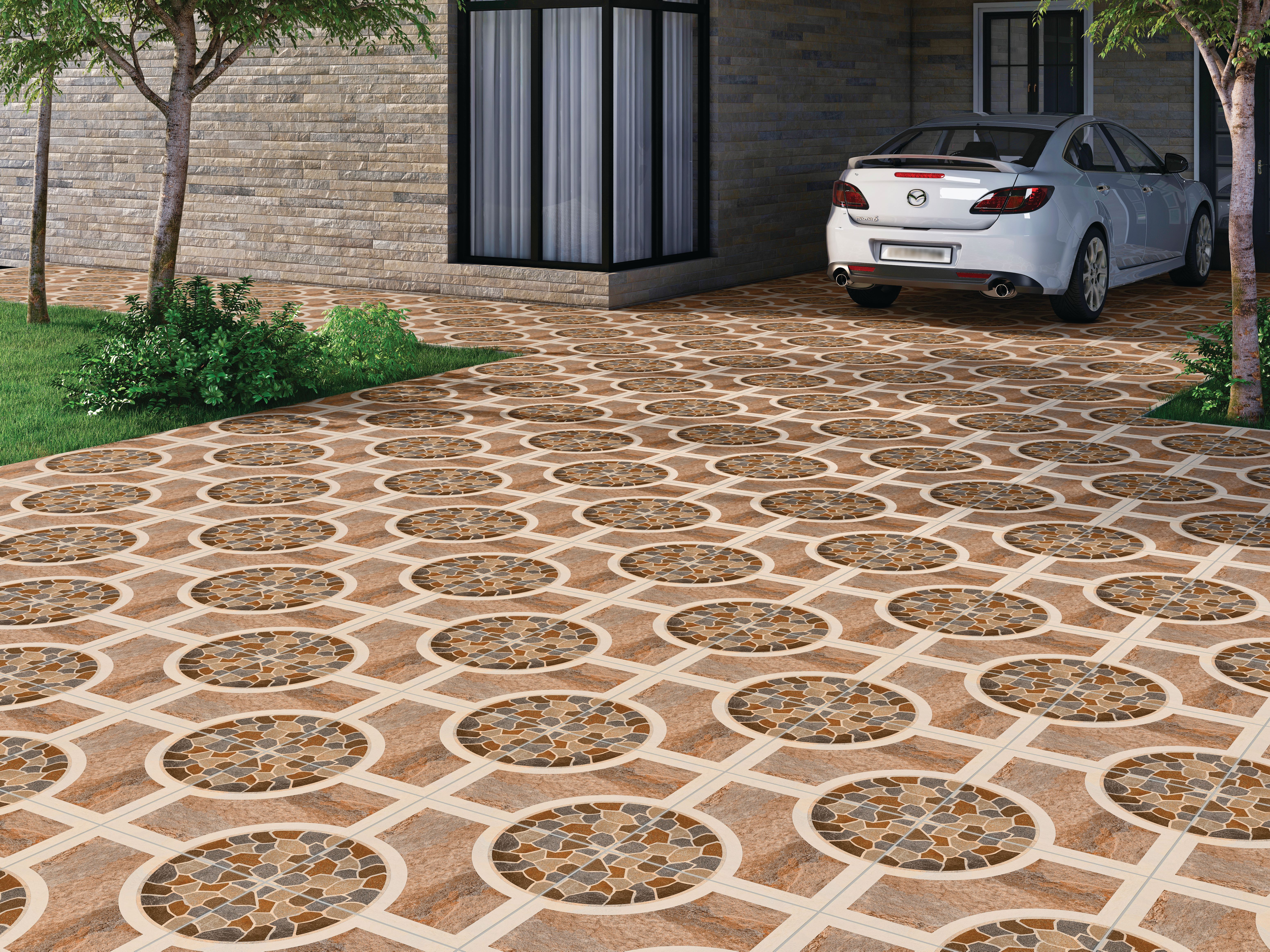
If you want a new design for your parking tiles, a stone look or a plain floor with a border keeps things simple. The strength and grip checks stay the same for every look below.
- Stone look with a random pattern: gives your outdoor area a natural look. Trevor Cotto is a matt design made for parking.
- Plain stone look: gives your parking area a clean, simple look. A modern parking tiles design for your home can be this simple, laid in a straight grid.
- Border around a plain floor: adds design detail without complicated cutting.
- Checker: a classic squared pattern that adds some detail to your driveway.
- Vertical lines: a simple lined pattern, and Platform Terracotta is a matt design made for parking.
- Rustic face: gives a rugged, stone-like surface, and Onega Dark is a rustic design made for parking.
Keep the layout simple where the wheels run, and lay the tiles in a straight grid there. You can lay checker tiles in a straight grid too, so you can still have them under the wheels. If you want a more interesting design, add a border and skip the angled layout across the whole floor, because diagonal and herringbone layouts use more tiles and need more cuts.
Pick a size that suits the slope and space
Durastone parking floor tiles come in 300 x 300 mm, and this smaller size makes slopes easier. The 300 x 600 mm tiles you may see alongside them are wall tiles, so keep them off the car floor.
The 300 x 300 mm size does mean more joints to keep clean. If you like a larger size from the Durastone range, such as 400 x 400 mm or 600 x 600 mm, check that parking is shown among its uses. The wrong size can raise the risk of cracking if the base isn't right, so ask your tiler too.
Your floor needs a slope whichever size you pick. Plan a gentle slope of 1:60 to 1:80 towards a drain. Over a 5 m driveway, that's about 6 to 8 cm of fall.
Parking tile designs compared: what suits where
Most of these choices suit some parking spots and not others, and only a glossy or indoor tile is a flat no.
Design choice | Where it suits | Watch out for | Verdict |
Dark grey or brown matt | Open driveways with dust and tyre marks | Lighter tones stay cooler underfoot in hot zones | Good for hiding daily dirt |
Mid-tone matt | Open or basement floors that stay damp | Still needs a slope, because puddles turn slippery | Good for hiding water marks |
Pale beige or cream | Spots you're happy to keep clean | Shows scuffs | Pick it only if scuffs won't bother you |
Rustic finish | Homes that want a natural outdoor look | Check that parking is shown among the design's uses | Good where looks and grip both matter |
Checker pattern | Driveways where you want some detail | Angled layouts need more cuts and extra tiles | Keep it in a straight grid under the wheels |
Border around a plain floor | Floors where you want some detail but a simple layout | Agree the border width with your tiler first | Adds detail without complicated cutting |
300 x 300 mm | Slopes and small bays | More joints to keep clean | Easy choice for sloped floors |
Glossy or indoor tile | Walls and dry living rooms, away from cars | Glossy can get slippery in rain, and indoor tiles aren't made for repeated load | Avoid for parking |
Tips for choosing parking tiles with samples
- Take two or three samples home and view them under your own lighting before you decide.
- Compare the samples side by side in the wet test, so you can feel the difference.
- Put each sample on your floor next to the dust and mud, and see which one hides them.
- Photograph each sample against your gate and outside wall, so you can compare them side by side.
- Agree the layout with your installer before you fix the size, because the layout affects your cuts.
- Use our tile calculator to work out your quantity, and choose a wastage allowance that suits your layout.
Mistakes to avoid when choosing parking tiles
- Don't pick a glossy tile for parking, because it can get slippery in the rain.
- Avoid ordinary indoor tiles, because a parking floor can fail when the tile isn't made for repeated load.
- Never lay parking tiles on loose sand, because they need a well-compacted, sloped concrete base and a polymer-modified adhesive.
- Don't skip the expansion joints in large open areas, because they absorb temperature changes.
- Avoid a flat floor, because tiny puddles turn into slippery films.
- Don't copy a neighbour's floor without checking where you park, because sun is the worry on an open driveway and damp is the worry in a basement.
Best parking tiles design for each kind of parking space
The right design depends on where the car stands. An open driveway needs grip and a colour that copes with sun and rain. A basement needs grip on a damp floor. On a sloped entry, smaller tiles make the slope easier, and you'll want a higher slip rating.
House parking tiles design for an open driveway
If your car stands under open sky, the floor gets sun, rain and temperature swings all year. Go for a matt or rustic finish, and pick a mid-tone or a dark tone so water marks and dirt don't stand out.
Large open areas also need expansion joints. The slope has to carry all the rain to the drain, because there's no roof to keep it off. Ask your tiler to show you where the water will run before laying starts.
Covered porch or stilt parking
A roof keeps off the direct sun and rain, so heat is less of a worry. You have more freedom with colour, and a lighter tile is possible if scuffs won't bother you. Wet tyres and shoes can still bring water in during the monsoon, so keep the same gripping finish.
Basement parking
Basement floors are prone to moisture, so grip comes first. Choose an anti-skid, matt or rustic finish, and look at a mid-tone if water marks are what you see most. Ask your tiler how water will reach the drain, because puddles turn slippery.
Sloped entry or ramp
If your floor rises from the road to the gate, smaller tiles like 300 x 300 mm make the slope easier to handle. Ramps also benefit from higher slip ratings, so ask for the R value before you choose.
SUVs, heavy vehicles and tight turns
Vehicle type changes what the tile and base must carry, so ask for that load figure with your actual vehicle in mind.
Turning wheels push sideways on the tile. So ask your dealer how well the design resists visible wear in turning spots, and keep to a straight grid there.
Checklist before you pay and on delivery day
Run through this list before the tiles are fixed:
- Parking is shown among the exact design's uses.
- You have the load specification and the R value in hand.
- All boxes have the same batch and shade code, which keeps colour and joint widths consistent.
- You've opened three or four boxes and dry-laid the tiles to confirm the match.
- You've set aside one or two boxes as spares, because shade can vary slightly between batches.
When to stop and call a tiler
A strong tile can still fail on a weak base, and many parking failures are base failures. Call a tiler or mason before you buy if you see any of these signs:
- The plan is to lay tiles on loose sand.
- The floor is uneven, loose or not firmly compacted.
- Water stays in puddles after rain.
- The load figure doesn't cover the vehicle you drive.
If tiles sound hollow after laying, there may be air gaps under them, and that can lead to failure. Ask your tiler to check them, and keep your spare boxes ready for any tile that needs replacing.
Once the base is sound, how the floor wears and feels depends on the tile type, its finish and the sun it gets.
How tile type, finish and sun change your choice
On a full-body tile, chips and wear show less over time. The finish changes your grip and the look, and in hot spots a lighter colour keeps the floor cooler underfoot.
Heavy-duty tiles and other tile types
For a floor that carries cars, we recommend heavy-duty vitrified tiles. Ceramic tiles suit bathroom and kitchen walls, backsplashes and low-traffic rooms, so keep them off the floor where you park.
Thickness varies by collection, so read it on the specification of the exact design. Then weigh it against your vehicle and base, because a thick tile on a poor base is still at risk.
Matt, rustic and structured finishes
Matt and rustic finishes both improve grip. Run the wet test on each to feel it for yourself. A rustic face has a more rugged look, which suits a natural outdoor area, and structured surfaces on Durastone add to the slip resistance.
Pick a finish that doesn't trap dirt too easily, so a routine wash keeps the floor looking good. Smudge some dust on the sample and wipe it off to see how it cleans.
Sun, heat and colour
On an open, sunny driveway, colour is a trade-off. Darker shades hide dirt, while lighter tones reduce heat build-up underfoot in hot zones. If you don't want to go dark or pale, a mid-tone is the middle option, and it hides water marks too.
Where a porch roof or stilt floor keeps the tile in shade, heat matters less. There, you can pick a darker colour mainly to hide dirt.
Durastone is compatible with heat-reflective technology like our Temp Shield, a cool tile technology designed for sun-exposed uses such as terraces and balconies. If heat is your main worry, ask whether the design you like comes with it.
Also Read: Texture layering over tiles, framed through Indian design philosophy
Conclusion
Picking a parking tiles design gets easier once you go in the right order. First make sure the tile is made for parking and comes with a load figure. Then check the grip, and only after that choose the colour, pattern, layout and size that suit your house.
Where you park helps you pick between two tiles you like. For an open driveway, go for a darker or mid-tone tile and a slope that carries rain away. For a sloped entry, go for smaller tiles. If the base looks weak, sort that out first, because a strong tile can't make up for it.
Once the floor is in use, wipe up oil spills quickly. To see a design before you buy, preview it in your own space with our tile visualiser, or bring your questions to one of our experience centres.
FAQs
Q. What type of material is best for parking tiles design at home?
Heavy-duty vitrified tile suits parking at home. It's made to carry vehicle loads and resist abrasion, oil stains and weather. Our Durastone range has a dense, low-porosity body, and its matt and structured finishes help with grip. Lay it on a well-compacted, sloped concrete base.
Q. Which colour is best for parking tiles?
Go darker if dust and dirt are your main worry. In a spot that stays damp, a mid-tone keeps water marks from standing out, and a pale tile only works if scuffs won't bother you. On a hot, open driveway, weigh this against lighter tones, which stay cooler underfoot.
Q. What size are parking tiles?
Durastone parking floor tiles come in 300 x 300 mm, a size that makes slopes easier. You may also see 300 x 600 mm tiles alongside them, but those are wall tiles. If you want a larger floor size from the Durastone range, check that parking is shown among its uses and ask your tiler about the base.
Q. How thick are vitrified parking tiles?
It varies by collection, so there's no single figure to rely on. Some parking designs, such as City Terracotta, are 10 mm thick. Check the specification of the design you like, and ask for its load figure too. Vehicle type, turning, drainage and laying quality matter as much as thickness.
Q. Are parking tiles vitrified?
Our Durastone ones are. They're heavy-duty vitrified tiles, with a dense, low-porosity body that suits moisture-prone and outdoor conditions. If you're buying another product, check its specification, because the name "parking tile" alone doesn't tell you what it's made of.
Q. Are parking tiles less slippery?
They can be, when the finish is right. Anti-skid, matt and rustic finishes improve grip and reduce slip risk in wet conditions, while a glossy tile can get slippery in rain. Ask for the R value on the specification, try the wet test with something steady to hold, and make sure the floor drains well.
Q. Can parking tiles take the load of heavy cars and bikes?
Yes, when the tile and the base are both right for the vehicle. Durastone tiles are made to carry vehicle loads, but ask for the load figure of the design you choose. Tell your tiler which cars and bikes will use the floor too, because turning movement, drainage and laying quality all play a part.
Q. Are parking tiles weather-proof?
They're made to handle weather, but the whole floor has to be right. Durastone suits moisture-prone and outdoor conditions. You still need a slope towards a drain, expansion joints in large open areas, an exterior-grade adhesive and a water-resistant grout. Polymer-modified grout also helps reduce hairline cracks.
Q. Can parking tiles be easily cleaned?
Yes. Sweep loose dust first, then wash with warm water, a mild detergent and a soft mop. Wipe oil quickly with an absorbent cloth, then wash what stays with a dish soap mix. Skip phenyl and acid cleaners, because they can wear down the surface and leave it patchy.
Q. What is the approximate price of car parking tiles?
There's no one fair figure, because the price depends on the exact tile and your site. The main cost drivers are tile type and finish, size, wastage, adhesive and grout, laying work, transport and site preparation. Get a quote for the full job from your dealer and tiler, with the base work listed separately.